Domestic violence happens in Johnson County more often than many realize. Keith Burchette believes survivors need somewhere to turn—and on November 1, he plans to give them one.
October is Domestic Violence Awareness Month, a national campaign meant to bring an often-hidden crisis into the light. The Tennessee Bureau of Investigation estimates that an incident of domestic violence occurs somewhere in Tennessee once every eight to nine minutes. Based on TBI statistics, Keith Burchette estimates that in Johnson County, it happens at least once every 34 hours.
Yet for survivors here, there has been no dedicated local resource to call, no local shelter to turn to.
Until now.
On November 1, Burchette will launch Safe Haven, an organization created to provide immediate shelter and support services to survivors of domestic violence while building something he believes Johnson County needs just as urgently: a community prepared to recognize abuse, respond to it and help prevent it.
For Burchette, the mission is deeply personal.
The Johnson County Line sat down with him to talk about the childhood experiences that brought him to this work, what happens when someone finally decides to ask for help, the particular dangers survivors face in a rural community, and his vision for what Safe Haven could become.
What follows is that conversation.
JCL: What did you see that made you realize that this resource was needed in this county?
KB: I have some lived experience. I grew up watching my father abuse my mother and sister.
JCL: I’m so sorry.
KB: No, no, no, no. This is—I don’t want to say it’s a blessing, but it’s something that I think can be turned into something. You know, most forest fires create better forests. So that’s how I see it.
I had an accident a few years ago, and it convinced me that working for a private manufacturing company was probably not the best use of my time. I became convinced that I needed to do something else in the winter of my career, my working life.
Then, in 2024, the former shelter closed its doors. There wasn’t a slow decline. It was, “We’re done,” and the doors were closed. Once I got into it, I saw the numbers, and it’s scary.
We don’t have the social infrastructure in this county to serve our survivors, and I know what survivors are going through. I watched it. So it’s heartbreaking for me to see those numbers.
JCL: Statewide data from the Tennessee Bureau of Investigation suggests that if Johnson County follows the overall Tennessee numbers, there would be 270 reported cases per year. Because so much goes unreported, what would you estimate?
KB: Based on statewide rates, we estimate about 270 reported cases annually in Johnson County. When you account for the cases that are never reported, we estimate the actual number could be closer to 460, but just on the reported cases that means it happens once every 34.6 hours.
We’ve done some research into what we think we’re going to see once we start offering these services in the county. Initially, we think we’re probably going to see around 100 a year that we actually have to house, and probably twice as many that are less severe cases.
The CDC says more than one in three women have experienced sexual violence, physical violence or stalking by an intimate partner during their lifetime.
So our number is based on polling of the county clerk, the district attorney’s office—
JCL: So the research you’re doing is rooted in what you’re hearing from the other resource agencies in the community.
KB: As well as looking at demographics and population. Everything we’ve got. And their numbers are a little bit more than that.
So we chose to say we’re probably going to do a little bit less, especially in the beginning. As we get more established, I think it’s going to go up.
JCL: I saw you’re going to be providing services for survivors of sexual violence as well, which appears even more likely to go unreported, particularly in areas like this. Justice Department estimates were that 70 percent of those cases go unreported. What happens to those people, and where do they go for help in Johnson County?
KB: Currently, if they have to seek those services, they leave Johnson County.
Ballad has a Sexual Assault Nurse Examiner who travels, and they’re trained to collect the evidence and work with the survivor during that time, if they choose to go. But there’s nothing here other than the standard law enforcement, DA, court, that I’m aware of.
JCL: Are there particular barriers in rural communities like ours that make people resistant to seeking help?
KB: This is the Bible Belt: stand by your man. You know, we’re supposed to stay together no matter what. There’s an ingrained belief, and that’s a small part. Some won’t let go. Some will actually stay. My mom stayed with my dad for 25 years.
Then there’s the financial. You’ve got to think, in our county, we are one of the poorer counties in the state. We are a distressed county. A lot of households are one-car households, and the breadwinner has the car. So that financial issue turns into a transportation issue. They just can’t get to it.
There’s logistics. These mountains—you can’t get cell signals. If they’re back in the holler somewhere, who are you going to call? You have no lifeline.
And there’s the stigma. They’re embarrassed. They don’t want to admit they’ve been abused.
JCL: Is that because they’re afraid everybody’s going to know about it?
KB: Exactly. Small town.
So you’ve got all this going on, combined with knowing there is no place to go. You don’t have transportation. The closest place is 40 miles over the mountain. All these things combined make it very difficult.
And it makes reporting difficult. Our statistics are all over the place. There’s no good system of reporting numbers, which makes getting help difficult.
JCL: The presence of children really complicates things too, especially for a woman who may be staying because she’s afraid she’s going to lose her children.
KB: That’s huge. That deeply complicated things with my mother because whenever she left, she had five kids. She would drag us along, us—the smallest kids. She wouldn’t dare leave us in that situation.
Most of the time there was substance abuse going on, so she wouldn’t leave us there. There were many nights of us sleeping outside, in cars. Many, many nights, you know, kind of clandestine, running and seeking shelter at relatives’ houses.
I can’t imagine what my mom was going through, not just worried about her own safety, but her children’s. It’s heartbreaking when I look out at the landscape of these numbers. It just breaks my heart.
JCL: What is the most dangerous point for someone who is in a domestic violence situation? Let’s say they were going to seek help. What should they do?
KB: Unfortunately, one of the most dangerous times can be when they decide to leave. The danger can escalate when they try to leave.
There is an escalation in these cases. It starts off small and leads up to something much bigger.
But once someone decides to leave and it’s found out that they’re leaving—remember, the folks who are doing the battering, it’s about control. Once they feel like they’re losing that control, that’s when they try to regain it under any circumstances. That’s the bad moment.
JCL: So let’s say someone reaches that point. How do they navigate that?
KB: One, they’ve got to be prepared. If you decide to leave, you’ve got to have a plan in place. You don’t just run.
You’ve got somewhere to go, some way to get there. If there are children involved, you’ve got considerations for them—food, shelter, on and on.
That’s why, whenever possible, we want someone to have a safety plan—somewhere to go and some way to get there. If someone is in immediate danger, that’s obviously a different situation.
JCL: What happens when someone contacts Safe Haven for the first time? Say you get a phone call and it’s like, “Is there someone I can talk to?”
KB: Now we’re talking about the future state, of course. We’re not up and running currently.
But we’ll have a 24-hour hotline. We will either show up on the scene—hopefully law enforcement is going to be working with us—and start that crisis management.
There’s a lot going on. There’s emotions. We’re basically going to do triage. Start with the important stuff: medical, physical, sexual assault. Make sure all those boxes are checked and everything is okay. Same thing for any kids.
Then we’re going to walk them hand-in-hand to a safe place. And that safe place is going to depend on the risk.
We’re going to use the nationally recognized Danger Assessment Tool developed by Jacquelyn Campbell that tells us whether this person is in no danger or serious danger. From that, we’re going to base their needs on that risk.
So we’re either going to keep them here in Johnson County or we’re going to cart them off to partner shelters farther away.
JCL: What services will you be providing directly, and which ones will you be partnering with other resources to provide?
KB: Whether they go to a local shelter or an away shelter, we’re still going to walk with them. We’re not just going to dump them off and leave them. We’re going to walk through this whole process.
We start with security, right? Then we start working on strength. We’re going to make them stronger. We’re going to set some goals.
Once we put them up in a place to stay, we’re not just going to warehouse them. We’re going to work with them. Okay, today you’re going to get out of bed. This is your goal. It may mean a menial task around the shelter. It could mean something big. You’re going to get a job. You’re going to get your own phone. Keep your hands busy and feel good about yourself.
And we’re going to supply their human needs. If they need clothes, we’re going to give them clothes. Food is obvious. We’re going to be their transportation.
For legal services, we have an agreement with Legal Aid of East Tennessee, and are working on a draft of an MOU with them. They do some of the minor stuff. We’re looking for partners who can do some of the deeper legal stuff, and certainly a pro bono attorney.
With orders of protection and walking through the legal system, there are resources a lot of people aren’t aware of, such as services to keep up with the perpetrator’s status in jail. Are they out of jail? All that stuff.
There are systems we can turn them on to so they know what’s going on and can make those decisions to help themselves.
JCL: Do they need to have police actively involved in their case to start getting resources?
KB: I’m not grant funded right now, but at some point I will be, and all the grants I’ve looked at pretty well stipulate that you can’t discriminate. You can’t turn someone away just because they haven’t sought police protection.
I’ve spoken with the previous shelter director about this, and he had situations where homeless people would show up, say, “Yeah, I’m abused,” and end up camping out at his place, taking up a bed.
So it’s a tightrope walk. We’re really going to have to mind ourselves and make sure the people who need that help get it.
JCL: The last time we spoke, you were looking for a place. Have you found that?
KB: There is a temporary place that we will not own. It’s owned by a ministry here in Johnson County. I basically did a presentation to them, and they asked what I needed. I said, “House, cars, money on an ongoing basis.”
And they said, “Well, what about this house?”
So we’re on the verge of signing an MOU. We’ll put them there, and we’ll walk with them through the recovery process.
JCL: So you will have a place if you need to do that immediate intervention where someone’s saying, “I need a place tonight for me and my kids.”
KB: Yeah.
JCL: So your goal is to take someone who has just been beaten down, literally, and is in crisis mode, and then build them back up so they can go forward. What’s the holistic vision for this?
KB: We’re a hub, and then we have spokes going out to all these different organizations—law enforcement, judicial, CPS, Health and Human Services. We have Frontier Health excited to help us out.
One of those spokes is the Magnolia Project, and this is a cornerstone of what we’re doing. Jennifer Ritter recognized early on that it’s about helping women in the community recover from being controlled.
She’s developed her course to take them through life skills, coping skills, job skills, hair and makeup, cooking skills.
JCL: Do you see that as being a huge hump to get over in terms of people being willing to say, “Okay, I’m going to make this long-term commitment to myself”? Do they have to leave the county?
KB: We wouldn’t encourage folks to leave the county, just to clarify. We think we have connections with enough services that they can continue to stay here where they live. Of course, if they want to leave, we’ll assist them.
I’ve spent the past two years creating this hub, having conversations and working on commitments. I’ve spoken to Melissa Holloway, Judge Lowe, Sheriff Brown, Mayor Potter, Mayor Jordan. We’ve got a very basic commitment from Frontier Health. I’ve spoken to multiple churches.
Everybody who would talk to us, who we think would somehow interface with those first-responding positions, we’re trying to bring them in.
My philosophy has been that there cannot be a successful standalone shelter that just sits out here like this tower: “Okay, everybody come to the tower, and this is where you’ll be helped.” That’s not going to work.
This issue has so many roots and so many different people are affected. You’ve got to pull in the whole community. That’s our goal. We want community involvement.
JCL: How do you protect confidentiality in a community this small?
KB: It starts with bringing in volunteers I think I can trust. They sign a Non-Disclosure Agreement coming in.
JCL: All your volunteers sign?
KB: Correct. And my board of directors. That’s paramount.
Once I am grant funded, they’re so strict on the records. The training I’m getting from the Tennessee Coalition Against Domestic and Sexual Violence on the Victims of Crime Act Grant, and the Family Violence Prevention and Services Act Grants suggest in some cases I’m not even supposed to keep the records once they leave my shelter. I’m supposed to destroy the records.
So secrecy is going to be paramount. Because it’s not just, “Hey, I’m telling somebody else’s business.” You could actually get someone killed.
I’m drilling that into the culture of the organization. Secrets save lives at this point.
JCL: What resources will you provide for current victims who maybe hear about you and call, but aren’t ready for you to get involved?
KB: First of all, you’re safe. That’s rule one. If they feel like their life is in danger, based on the situation, we’re going to advise them on what we feel is the safest thing for them to do at that time. That’s number one.
Other than that, it depends on their needs. Do you need a car? Do you need a ride? We’re offering that.
But we can give them a host of information. You don’t want to leave? That’s fine. You’re not ready to leave? Maybe pack up these items and have them ready. Here’s a phone number. Write it down, but don’t write who it’s to. Don’t put it in your phone. Here are some security tips to keep prying eyes out of your phone.
Unless they ask for something tangible, what I can do at that point is give them information.
JCL: Let’s say someone reading this knows or loves someone who is in this situation. What would you tell that person?
KB: One thing: we won’t go through an intermediary. We’re going to talk to the victim. Safest thing to do.
Tell them to call us at the safest time for them, and we’ll listen to their situation. There’s no formula that guarantees success. Everything’s situational. We have to evaluate what’s happening and what the risk is, and then we can guide them.
Maybe you can pack a bag and get ready to go. Whenever you’re ready, you say the word and we’ll meet you here. We’ll pick you up.
We can provide you with those escape choices.
JCL: You talked about the connections you’ve made, and you mentioned the churches. What do you want pastors and ministers to know?
KB: Look out at your congregations. Count the women. There’s a hundred in there. Statistically, a significant number of them have experienced intimate partner violence. Think about that.
The person who shakes your hand every morning coming into church, and the hand of the man that’s with her—that’s the hand that’s laying on that woman. That should disturb you.
So I get it, Pastor. You’re charity fatigued. You don’t know me. You don’t know my organization. But what you do know: there’s a problem.
What I would ask XYZ Church is, listen to what we have to say. Let me come talk to you, your leaders and your congregation. It starts with a conversation. I’m not asking you for anything. Just listen. Talk to me.
After that, don’t feel obligated to write me a check. I’m not asking for your check. The biggest currency this organization and this community needs is partnership.
Partner with us. There’s a million ways. You can give money. I’m not against it. But more valuable to me is having a partnership—for you to call me and say, “Look, I’ve got a couple who’s in distress. What can you do?” Or I call you and say, “Look, we need a hundred escape bags put together. Here’s all the ingredients. Get your church to put them together.”
Partner with us. Talk to us. Wherever there’s a group of people gathered, we want to be in that group.
JCL: That question got an emotional response from you. Can you tell me why?
KB: People have a perception that everything’s great. And I guess it helps them sleep at night. But my life experience has been that it’s not.
No matter what the family looks like on the outside, there could be problems. I’m not trying to hypochondriac an issue onto the county, but I know it’s there.
I can walk through the grocery store now, and I can see these women who are just—you can look at them and tell from their interactions, especially when their significant other’s around. It’s obvious.
I get excited when people start talking about this subject, and I get really sad when I hear an official say, “Oh, that’s not a problem here. We’ve never took anybody over there to the shelter.”
To ignore it is a travesty.
What we’re doing now, fixing domestic violence problems, we’re fixing future problems that aren’t just going to be domestic violence. They’re going to be robbery. They’re going to be rape, murder, drugs.
Because the statistics say when these children see mommy and daddy in that situation, especially the boys, they’re more likely to repeat that activity. A 2010 study found an approximately 60% increase in risk that boys who witness intimate-partner violence during childhood have an increased risk of perpetrating intimate-partner violence later in life.
And so it affects society.
JCL: In your vision, if you could get the county to respond in this way, what would that look like?
KB: Johnson County would have a secure shelter housing about three families at a time. We would have the means to transport those victims at any given moment, any time.
We would have a staff of about four people, with about as many volunteers following up with them.
We’d be totally entrenched in the community and have community support—partnerships, like I’m speaking of, more than anything.
That’s the three-year plan.
JCL: Okay.
KB: Three to five years, we want to work on the other side of the fist.
Most males are not going to wake up one day and say, “You know, I’m going to go beat the crap out of a girl.” Something has happened in their life. Something’s broken. So we want to work with those guys.
That would mean a batterer intervention program, and probably two to three more staff members, licensed counselors.
If there is a battery event, the perpetrator has to come sit in with us for 26 weeks through a sanctioned, certified batterer intervention program.
If they just go to jail, they’re just going to get more mad. They’re not going to come out and say, “Boy, I won’t do that again.” Jail alone doesn’t necessarily address the behavior that led to the abuse. And if someone hits you once, don’t assume it can’t happen again.
I’m not Pollyanna. I’m sure there are some that are just unfixed monsters. I get that.
But we need to make that effort to work with these folks who batter. There’s a reason behind it, and it won’t be a fluff course. It won’t be anything on the internet. This is going to be some heavy, man-to-man, sit-across-from-you—it will be intense.
JCL: If people want to get involved or write you a check, what should they do?
KB: Facebook’s the easiest way to get a hold of us right now. We have a website, SafeHavenofJC.org. And there is a donation button. Real simple. Very, very easy to do.
KB: Continuing with our plan, after five years, we feel we’re going to be a staple of Johnson County and Mountain City. Everybody knows who we are.
There’s a segment of the population, the 18-to 24-year-olds, who experience episodic spikes according to the Tennessee Bureau of Investigation’s TIBRS crime statistics for Johnson County. So we recognize that it’s not just married folks. A lot of the time, it’s unmarried, 18 to 24.
We want to work with these young men and young women. That means some interaction in school, as the school will allow.
That’s why we have to get a presence and an understanding of who we are. We want our school folks to feel comfortable that we might be an approach to the school-age folks in that setting, if possible.
We definitely want to pay attention to that group, because 17 to 24, 25 to 34, and 35 to 44 is where we’re seeing the most of this.
JCL: When is this launching?
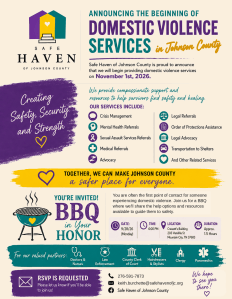
KB: November 1. That is going to be D-Day. That’s the official start of service. We’re gearing up for that.
That’s when we’re going to officially publish that 24-hour hotline number.
I’ll be carrying flyers to all the area health departments, hospitals, the places where survivors would be able to go separate from the perpetrator, with our number on it.
So we’re officially letting everybody know that we’re going to take a swing at this. Here we go.
JCL: And you will have the house set up by then?
KB: Yeah.
JCL: So you have volunteers already?
KB: Yeah, we’ve got five, six counting myself.
JCL: All right. What else do you want to tell me?
KB: September 28th, Monday, we’re having a banquet for what we call domestic violence first responders.
Anybody who would come in contact with a survivor on that first thing: hairdressers, EMTs, of course sheriff, police, clergy. We’re inviting all these folks in.
Safe Haven on Facebook
Safe Haven Website

