Editor’s Note — Updated September 10, 2026: This article has been updated to clarify the insurance status of an E-911 employee facing a serious illness. The employee has not yet lost her primary medical coverage. She says that coverage was threatened with termination at the end of August but was extended through September while she is on FMLA leave. However, she reports losing her short-term disability, long-term disability, and life-insurance benefits because of unpaid premiums. Her September 3 surgery was postponed while the status of her medical coverage remained uncertain. Additional details have been added below.
Comptroller cites confidentiality law while directing requests for local records back to the E-911 district.
Questions surrounding the finances and oversight of the Johnson County Emergency Communications District continue to grow after the Tennessee Comptroller’s Office responded to a public-records request but provided no additional E-911 audits beyond the district’s fiscal year 2022 report.
The Johnson County Line requested records while examining concerns involving the district’s financial reporting, employee benefits and governing-board oversight. In its response, the Comptroller’s Office directed us to its online audit database and included a link to the Johnson County E-911 audit for the fiscal year ending June 30, 2022. The office also linked Johnson County’s fiscal year 2025 Annual Financial Report summary.
However, the county’s annual report is not the same as a separate audit of the Johnson County Emergency Communications District. We have not located publicly released district audits for fiscal years 2023 or 2024, and neither report was included in the Comptroller’s response.
That leaves a basic unanswered question: Where are the 2023 and 2024 Johnson County E-911 audits?
The question became more pressing after a scheduled E-911 board meeting on September 4 was reportedly canceled because officials were still waiting for the district’s 2025 audit. The Johnson County Line is seeking confirmation of who canceled that meeting, the stated reason for the cancellation, and when the board intends to meet again.
An unfinished audit would not, by itself, explain the missing public trail from the two preceding fiscal years. It also does not answer why the governing board could not meet to address current operations, employee concerns, and the status of corrective action.
What the 2022 audit documented
The publicly available fiscal year 2022 audit identified Kevin Colson as the district’s director and documented several findings involving the district’s financial controls.
Auditors reported that pension contributions had not been made on all eligible wages. They also found that expenditures were not always properly classified against the district’s adopted budget and that financial statements were not submitted on time because of weaknesses in monthly and year-end closing procedures.
District management agreed with the findings. The corrective-action plan identified Colson as the responsible contact and described completion of the corrective measures as “ongoing.”
Those findings were not hidden or speculative. They appeared in a public audit issued by the Comptroller’s Office.
Documents obtained by The Johnson County Line also include a March 2025 E-911 board agenda requiring Colson to appear before the board to address financial and administrative concerns. What has not been made publicly clear is what explanation was given, what action the board took, or whether the problems identified in 2022 were ever fully corrected.
Colson has since resigned, and Willie DeBord is serving as interim director. But a change in leadership does not resolve the need for a full accounting of the district’s finances, its employee obligations and the board’s oversight.
What the Comptroller says is confidential
In its response, the Comptroller’s Office stated that any other records in its possession containing the requested information would be confidential under Tennessee Code Annotated § 10-7-504(a)(22).
That provision protects the Comptroller’s audit working papers, including auditee records supplied to the office, internal communications, draft reports, schedules, notes, memoranda, and other records related to an audit or investigation. It also protects information received or generated by the Comptroller containing allegations of unlawful conduct or fraud, waste or abuse.
In other words, the Comptroller may be legally prohibited from releasing its unfinished audit material, internal communications and allegation files.
But the exemption does not necessarily make every record originally maintained by Johnson County E-911 confidential. The district’s own approved minutes, meeting notices, financial statements, corrective-action records, contracts, invoices and other routine public records remain subject to the Tennessee Public Records Act unless the district can identify a separate exemption that applies to a particular record or portion of a record.
The Comptroller’s response itself directs us to contact Johnson County E-911 for additional information.
The consequences are not confined to paperwork
This story is not simply about delayed reports or accounting procedures. According to an E-911 employee currently facing a serious illness, the district’s financial and employee-benefit problems have already disrupted her medical care and eliminated other coverage she believed was in place.
The employee clarified that she has not yet lost her primary medical coverage. She said the coverage was threatened with termination at the end of August but was extended through the end of September while she is on federally protected Family and Medical Leave.
The uncertainty nevertheless had immediate consequences. Her surgery, originally scheduled for September 3, was postponed because the status of her coverage had not been resolved before the procedure. She has obtained legal representation and is working to ensure that coverage will remain in place for her rescheduled surgery and postoperative care.
The employee said she did lose her short-term disability, long-term disability and life-insurance coverage because premiums were not paid. She alleges that lapses involving benefits deducted through payroll date back to 2024.
She also said all financial payments available to her were stopped while district officials awaited guidance from the Tennessee Comptroller’s Office about how she could legally be paid. According to the employee, that has left her unable to meet household expenses and pay medical copayments while undergoing treatment.
Her medical coverage beyond September remains uncertain. Questions also remain about the status of supplemental benefits for which premiums were reportedly deducted through payroll.
These statements describe the employee’s account of her circumstances. The Johnson County Line is seeking records and responses from district officials to determine what premiums were deducted, which payments were transmitted or missed, when policies lapsed, who knew about the problems and what is being done to restore the employee’s benefits and address her financial losses.
We are withholding personal medical details that are not necessary to the public-interest issues raised by her experience. Her account, however, demonstrates why this cannot be dismissed as delayed paperwork. Problems involving employee benefits can lead to postponed medical care, unpaid bills and the loss of protections employees believed they had earned and paid for.
Oversight cannot stop with one former director
The district is governed by a public board. Its responsibility is not limited to receiving an audit after the damage is done. The board is expected to oversee finances, ensure that employees receive the benefits promised to them, and require corrective action when auditors identify deficiencies.
Questions also remain about when county leadership became aware of the district’s problems. The relevant issue is not whether the county mayor personally managed the independent E-911 district. It is what county and board officials knew, when they knew it, what authority they had, and what actions they took after being notified.
The public needs more than assurances that the situation is being handled. It needs dates, records, corrective actions, and an explanation for the missing audits and canceled meeting.
Questions that still require answers
The Johnson County Line is seeking answers to the following:
- Were separate Johnson County E-911 audits completed for fiscal years 2023 and 2024? If so, why are they not publicly available?
- If those audits were not completed, why not, and who was responsible for providing the required financial records?
- What is the present status of the district’s fiscal year 2025 audit?
- Was the September 4 board meeting canceled because the 2025 audit was unfinished? Who made that decision, and when will the meeting be rescheduled?
- What occurred when Colson was called before the board in March 2025, and what corrective action followed?
- Were all required retirement contributions eventually deposited, including any employer match, interest, losses or penalties owed to employees?
- Were employee health-insurance premiums deducted or otherwise owed but not transmitted to the insurance provider?
- Were any employees threatened with or subjected to interruptions in medical, disability, life-insurance or other employee benefits, and what is being done to restore those benefits and address the resulting harm?
- When did members of the E-911 board and county leadership first learn about the financial and employee-benefit problems?
- Why have meeting minutes and other basic records documenting the board’s response not been posted or provided?
- Who currently has responsibility for the district’s finances, and what safeguards have been put in place?
- When will the public receive a complete accounting?
The Johnson County Line is not alleging that any particular person committed a crime, nor are we drawing conclusions that go beyond the available records. But the existing public record already establishes financial-control deficiencies in 2022 and corrective measures that were still described as ongoing. The March 2025 agenda shows that serious concerns remained before the board nearly three years later. See documentation below.
Now the public is confronted with two missing years in the district’s published audit trail, a 2025 audit that reportedly remains unfinished, a canceled board meeting, and allegations that an employee’s access to health care has been affected.
Johnson County’s 911 employees perform essential and demanding work for this community. They deserve the pay and benefits promised to them. The public deserves accountable oversight. And everyone deserves a clear answer to the most fundamental questions: Who knew what, when did they know it and what did they do about it?
The Comptroller’s response, the fiscal year 2022 Johnson County E-911 audit, and the March 2025 board agenda are included with this article. The Johnson County Line will update this report as additional documents and responses become available.
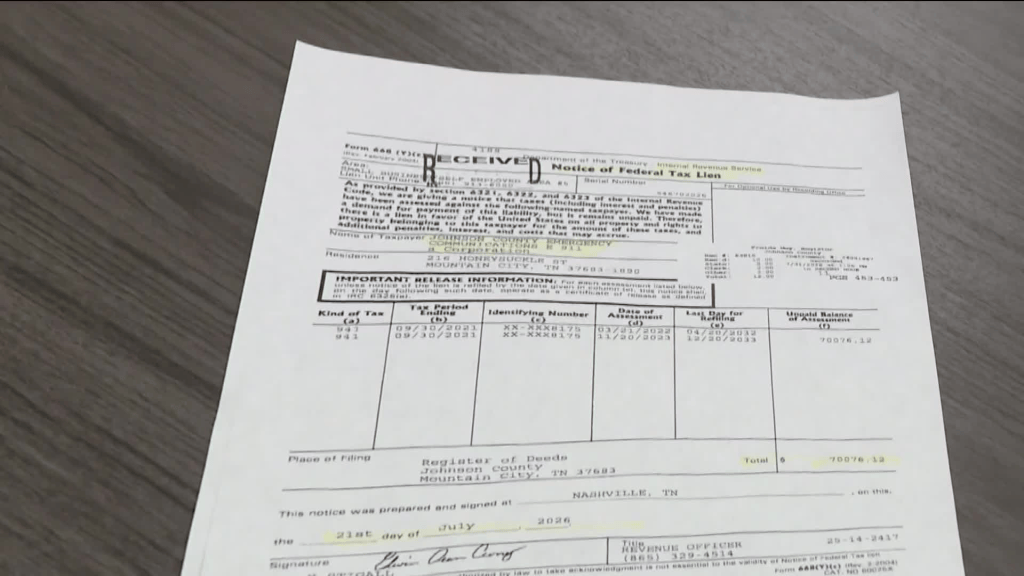
Notice of Federal Tax Lien – July 21, 2026 SOURCE: WCYB