
There was plenty to talk about at Tuesday evening’s Mountain City Board of Mayor and Aldermen meeting, from questions about the proposed modular AI data center to more than $3 million in street and sidewalk improvements, plans for parks and recreation, and concerns about dropping water levels at Silver Lake.
And there were a few questions that didn’t get answered.
Here’s what happened and what we’ll be keeping an eye on.
Is the Proposed Data Center Rezoning Still on the Table?
That was one of the first questions raised during public comments.
As we’ve previously reported, the Mountain City Planning Commission voted unanimously on October 22 to recommend denying the M-2 rezoning request for the proposed BluSky AI data center on the property on Shady Street.
But what happens next?
Eva Jensen, a county resident in Laurel Bloomery, asked Mayor Jerry Jordan whether the rezoning application had officially been withdrawn.
Jordan said it was not on Tuesday’s agenda.
When asked whether it might appear on the next agenda, he responded, “We just have to wait and see.”
The mayor said he had heard rumors but had not seen anything confirming that the application had been withdrawn.
So, for now, we still don’t have an official answer about the application’s status or whether it will come before the council.
Questions About Public Access to the October 22 Meeting
Angela Rothermel, a Mountain City resident, also addressed the council, raising concerns about the number of people who were unable to get into the October 22 Planning Commission meeting.
That meeting drew a large crowd because of the proposed data center. Once the room reached its fire-code capacity, additional residents were left outside, unable to see or hear what was happening.
Rothermel said she had researched Tennessee’s Open Meetings Act (TOMA) often called the Sunshine Law, and believes the town may have violated its requirements.
Her concern was that officials knew the issue was controversial and should have anticipated a larger crowd.
She questioned why the meeting wasn’t moved to a larger location, postponed, or made accessible through audio or video for those outside.
Rothermel made it clear she wasn’t accusing anyone of deliberately excluding residents. Her point was that people should have been able to observe a public meeting involving an issue that could have a significant impact on their community.
She told council members she had filed a complaint and was encouraging others to do the same.
It’s an important question, and one that goes beyond the data center. What happens when a public meeting draws more people than the room can hold? How does local government make sure residents have a reasonable opportunity to see and hear what’s happening?
Tennessee law requires governing body meetings to be open to the public, although whether this particular situation violated the law has not been established.
There was no response from council members before the meeting moved on to regular business.
We’ll continue following both the rezoning application and the concerns about public access.
$3.1 Million Approved for Safer Streets and Sidewalks
Now, on to one of the biggest financial decisions of the evening.
The council unanimously approved the Mountain City Safe Streets Project, which will bring more than $3.1 million in street and sidewalk improvements to town.
The project is funded through the federal Safe Streets and Roads for All program.
Here’s how the funding breaks down:
- Federal funding: $2,482,850
- Town’s share: $620,713
- Total: $3,103,563
The town’s portion will come from its General Fund.
The project will focus on safety and sidewalk improvements along five corridors in Mountain City.
That’s a pretty substantial investment, particularly for a town our size.
There wasn’t much discussion before the vote, and the five corridors weren’t identified during the meeting.
We’ll be looking for more information about which streets are included, what improvements are planned, and when the work might begin.
Parks and Recreation Planning Gets the Green Light
This is another project we’ll be interested in following.
Council members unanimously approved an agreement with Pape-Dawson Consulting Engineers to develop a Parks and Recreation Master Plan for Mountain City and Johnson County.
It’s a joint town and county project, funded through grant money and matching funds from both governments.
Who Is Pape-Dawson?
Pape-Dawson is an engineering and planning firm that works on projects ranging from infrastructure and community development to parks, trails, greenways, and recreation planning.
And here’s something interesting.
The company is also working with the City of Bristol, Tennessee, on its 2026 Parks and Recreation Master Plan.
What About Our Parks and Recreation Needs?
That’s where things get interesting for Johnson County.
A master plan is intended to look at what a community already has, what it needs, and where future investments should be made.
That could include everything from existing parks and playgrounds to walking trails, sports facilities, recreational programs, and other opportunities for residents of all ages.
It can also help establish priorities when grant funding becomes available.
We’ll be following this one closely.
Keeble Questions What Happened to $500,000 for Street Paving
Outgoing Alderman Lawrence Keeble had a question for the mayor.
Back in September, the council voted to pursue approximately $500,000 in borrowing for additional street paving.
So, what happened to that decision?
Keeble wanted to know why the town hadn’t moved forward with the action approved by the council.
Mayor Jordan explained that after reviewing the town’s finances, he believes it would make more sense to use money from reserves rather than borrow.
Jordan said the town has enough money in reserves to cover the additional paving and questioned why it should pay interest on a loan when the money is already available.
Keeble pointed out that borrowing at a favorable interest rate could allow the town to keep its reserves available for other needs.
But his bigger concern was that the council had already taken action, and two months had passed without that decision being carried out or formally changed.
Audra Gerty, Mountain City Recorder, said a proposal from the financial adviser had been received and could be presented at the December meeting.
The mayor said the town still plans to complete more paving in the spring, whether the money comes from reserves or borrowing.
No new vote was taken Tuesday to change the September decision.
It’s worth following, not only because of the additional paving, but also because of the question Keeble raised about how previously approved council actions are handled.
Silver Lake Is Dropping — And the Town Is Watching
Here’s another issue that caught our attention.
During department reports, a water department representative told the council that Silver Lake had dropped about two feet from its previous reference level in approximately one week.
The lake had been near overflow the previous week, but the recent dry weather and additional water usage have officials watching conditions more closely.
The department plans to check the lake’s level daily.
That led to a discussion about what the town has done during previous dry periods.
Town employees recalled pumping water from a nearby creek into Silver Lake in 1999 and 2000, when conditions became particularly severe.
Doing that again would require approval from state environmental officials and some preparation.
No action was taken Tuesday, but council members discussed revisiting that option if water levels continue to fall.
Hopefully, we’ll get some much-needed rain before that becomes necessary.
A Change in Plans for Wastewater Funding
The town has been working for more than two years on a State Revolving Fund financing application to help purchase another sludge press for the wastewater treatment plant.
But now there’s a better funding option.
Mayor Jordan explained that the equipment could be covered through an Economic Development Administration (EDA) grant.
The original financing option included a loan with a 40% grant component, meaning the town would still have to repay part of the cost.
With the EDA funding available, council members unanimously agreed not to move forward with that particular loan application.
The town is still pursuing a separate State Revolving Fund application for water system improvements.
Personnel Changes and a New Project Coordinator
The council approved several personnel changes, including a new Project Coordinator position.
Brian Link was approved for that role, which will help oversee the town’s growing list of projects, including those connected to the EDA grant.
Council members discussed whether the position should be permanent, given that much of the upcoming work involves grant-funded projects.
They agreed to review the position after four years.
Other personnel actions included approving Andrew Allen as Collection and Distribution Manager, transferring Jody Wagner to the water department, accepting the resignation of part-time HR Associate Makayla Philippi, and hiring Emilie Stonecipher for that position.
All were approved unanimously.
A Few More Items from the Meeting
Planning Commission: Billy Walker was appointed to fill a vacancy on the Planning Commission.
Health Insurance: The council approved the town’s BlueCross BlueShield renewal for 2026–27. The increase was just 1.95%, which even surprised the mayor.
Little League Restrooms: A request from Little League representatives was discussed to connect a portable restroom facility at the Mountain City Elementary School ballfields to the town’s sewer system. Council members want more information about maintenance and responsibilities before making a decision.
Property Cleanup: Alderman Jerry Horne asked about progress on cleaning up neglected lots and removing junk. The proposed committee still doesn’t have enough volunteers, but the town continues responding to complaints.
Community Center: Vice Mayor Celeste Dunn had some good things to say about improvements to the Community Center recreation room and praised Director Joey Beth Souder for her work.
Wastewater Plant: The council also renewed a technical service agreement covering maintenance of monitoring equipment and other electronic systems at the plant.
A Thank You to Lawrence Keeble
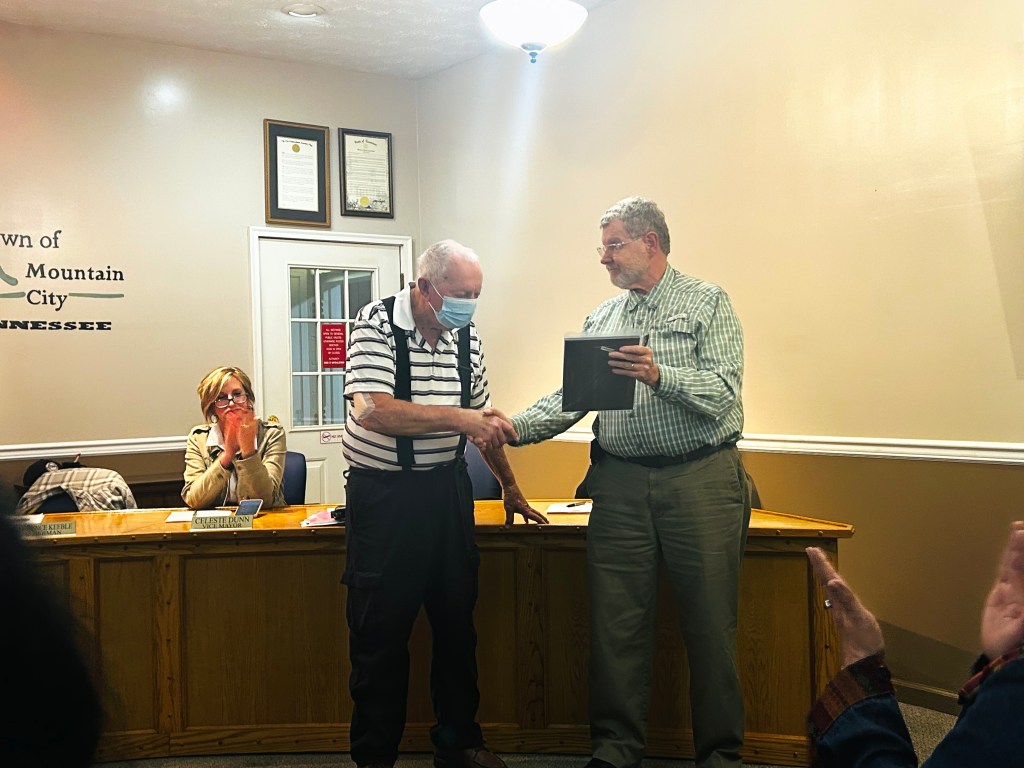
The evening also included a special recognition for outgoing Alderman Lawrence Keeble.
Keeble was presented with a plaque honoring his years of service to Mountain City, including four terms as alderman and his time as mayor from April 2011 through December 2016.
Keeble, who said he’ll turn 86 in a few days, shared a little Kenny Rogers wisdom about knowing when it’s time to call it a day.
He said he’s enjoyed serving Mountain City and wished the town all the best.
Council members thanked him for the many years he’s given to the community.
A Few Dates to Remember
Wednesday, November 11 — Veterans Day: Garbage normally collected Wednesday will be picked up Thursday, November 12.
Friday, November 27 — Thanksgiving Holiday: Friday’s garbage collection will move to Monday, November 30.
Monday, November 30, 9 a.m.: Swearing-in ceremony for the newly elected aldermen at Town Hall.
Monday, November 30, 10 a.m. (tentative): Dedication of the Porter Stout Memorial Bridge near the entrance to Johnson County High School, provided the signs arrive in time.
What’s Next?
There was a lot packed into Tuesday’s meeting, and several things we’ll be following.
We still don’t have confirmation about the status of the proposed data center rezoning. Questions remain about public access to meetings when large crowds are expected.
The town has approved a substantial investment in safer streets and sidewalks, and the joint parks and recreation master plan could help shape what recreational opportunities look like in Johnson County for years to come.
We’ll also be watching what happens with the additional paving, how Silver Lake responds to the dry weather, and when residents will have an opportunity to share their ideas for parks and recreation.
As always, we’ll keep asking questions, following the decisions, and sharing what we learn.
That’s what we do here at The Johnson County Line.

