
Residents turn out in opposition as BluSky AI makes its case. Mayor Jordan says he hears the community’s concerns.
October 22, 2026 — Mountain City residents made their feelings known this afternoon at Town Hall, and the Planning Commission agreed.
Following a lengthy meeting that included public comments, a presentation from BluSky AI representatives, and questions about everything from noise and electricity to property values and zoning, the Mountain City Municipal Planning Commission voted unanimously against recommending a zoning change for a proposed AI data center on South Shady Street.
The request came from local businessman and property owner Jim Phipps, who sought to change the zoning of property at 1455 South Shady Street from M-1 (light industrial) to M-2 (heavy industrial) to accommodate a proposed modular AI data center.
For many of those attending, the proposal brought back memories of the controversial Bitcoin mining project that divided the community last year.
But Thursday’s discussion also brought some new information, including details about BluSky AI’s proposed technology, its anticipated electrical needs, and the potential economic benefits the company says it could bring to Mountain City.
And, perhaps most importantly, it brought a clear decision from the Planning Commission.
Mayor Jordan: “I hear it”
Near the end of the meeting, Mayor Jerry Jordan acknowledged what had become apparent throughout the afternoon — the residents who turned out were overwhelmingly opposed to the proposal.
“Whole room, they’re all against it, 100%, and I get it. I hear it,” Jordan said.
The mayor also spoke about the difficult balance between attracting new businesses and respecting the wishes of the community.
While expressing disappointment at the possibility of losing an opportunity for economic development, Jordan made his position clear.
“I’m not gonna vote to approve this rezoning.”
The commission subsequently voted unanimously against recommending the zoning change.
It’s important to understand that the Planning Commission makes recommendations on zoning matters. The town’s Board of Mayor and Aldermen has the authority to take final action on rezoning ordinances.
Neighbors worry about what comes next
While BluSky representatives focused on the differences between their technology and larger data centers, residents focused on something closer to home.
What would this mean for the people who live, work, and own property near the proposed site?
Nela Pleasant, who said she and her husband own property just two doors down, told commissioners they have invested substantial money in a restaurant they are developing and is scheduled to open next spring.
The business includes an outdoor area, and she expressed concern that a nearby data center could affect the atmosphere they are working to create.
Other speakers worried about mechanical noise, property values, the cost and availability of electricity, and the possibility of additional industrial development in the future.
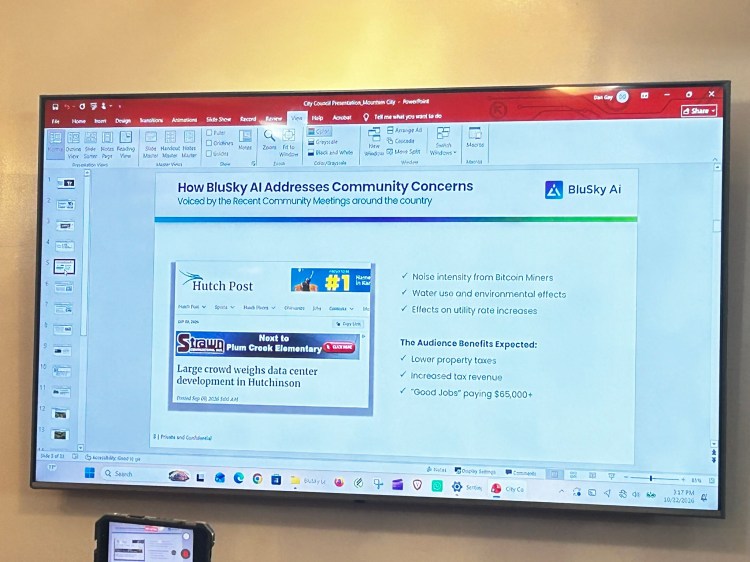
Several reminded commissioners of the community’s experience with the earlier Bitcoin mining proposal.
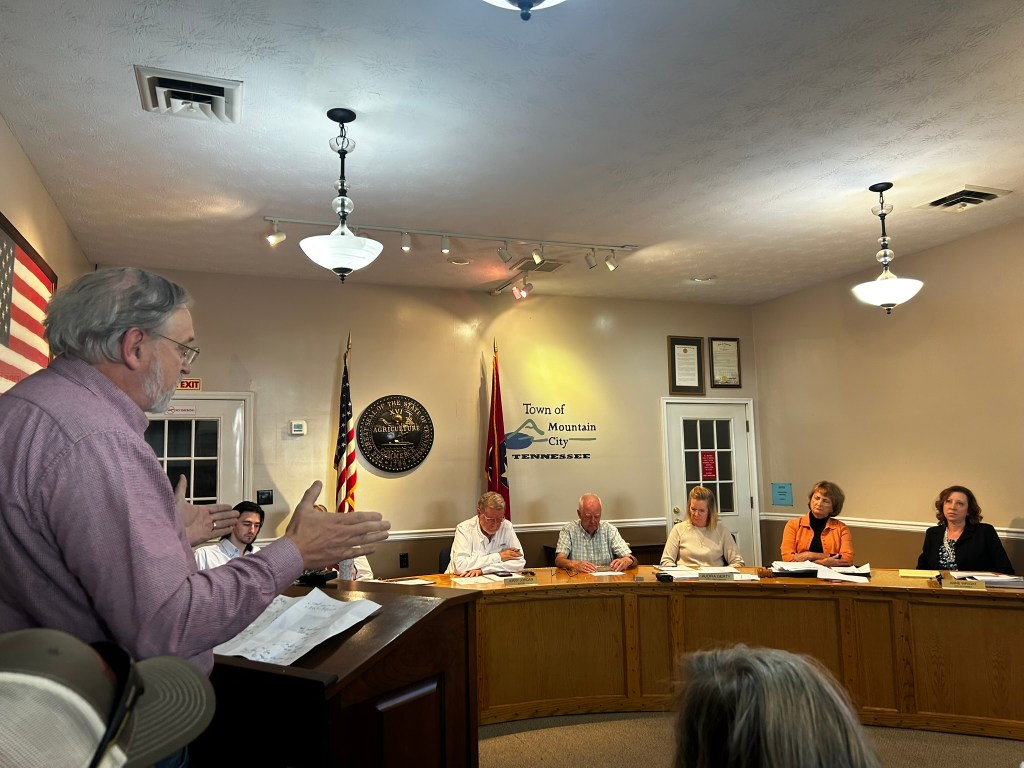
Attorney questions the proposed zoning change
Local attorney Bill Hart raised another issue — whether changing the zoning classification for this particular property could amount to improper spot zoning.
Spot zoning generally refers to a zoning change that gives special treatment to a particular property in a way that may conflict with the surrounding area or broader land-use policies.
Hart argued that the proposal raised those concerns and reminded commissioners that zoning laws are intended to protect public health, safety, and welfare.
He also questioned whether the town currently has sufficient regulations in place to address the impacts of data centers, including noise, environmental concerns, and future expansion.
The Planning Commission did not make a legal finding on spot zoning, but Hart’s comments added another issue for officials to consider.
And although BluSky representatives repeatedly emphasized that their technology is different, some residents said they were not comfortable relying on those assurances without independent verification.
For others, the question was even simpler: Is this the right location for this type of development?
A property owner looking for opportunity
Phipps told those attending that he had owned the property for several years and invested considerable money preparing it for development.
He said he had been trying to attract a business to the property along the four-lane highway and believed this proposal deserved a fair hearing.
Phipps also made a point of saying he had opposed the earlier Bitcoin mining proposal and believed the BluSky AI project was something entirely different.
He told commissioners that he had not signed a lease or other agreement with BluSky AI.
For Phipps, the request was about changing the zoning classification to allow additional development opportunities on property he has worked to improve.
But for neighboring property owners, the proposed change raised concerns about what could ultimately be built there — not just now, but in the years ahead.
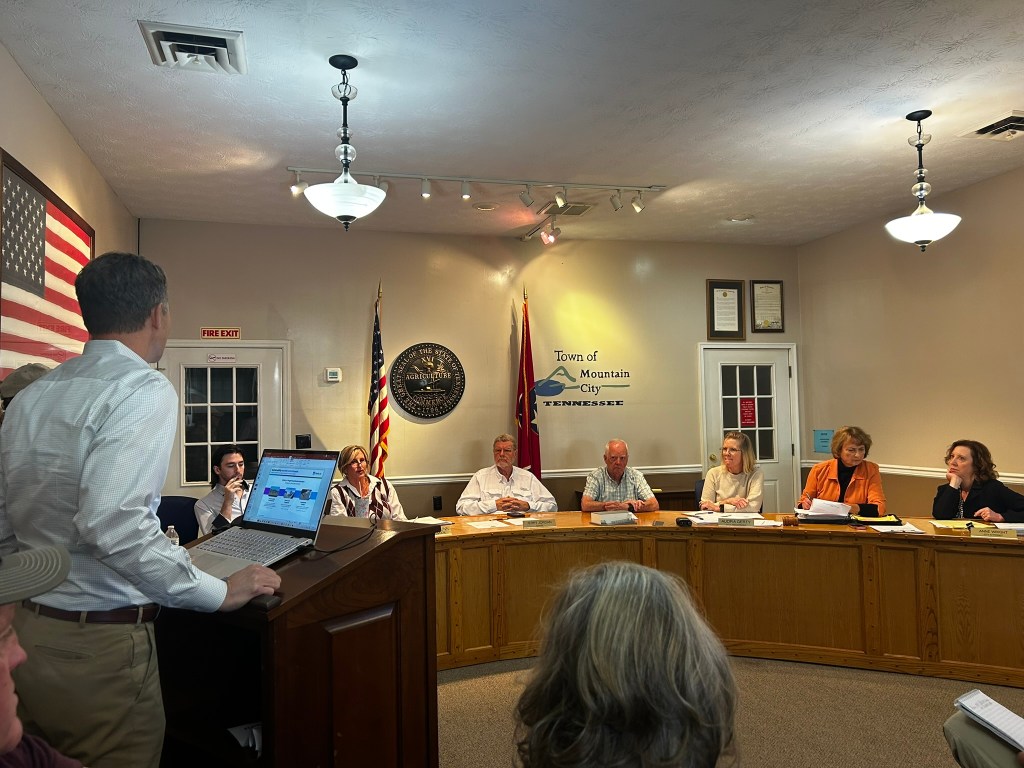
BluSky AI says its technology is different
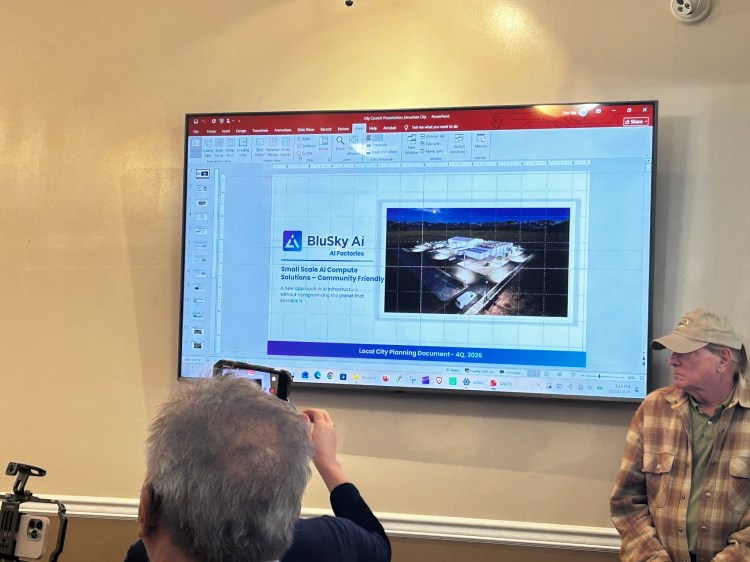
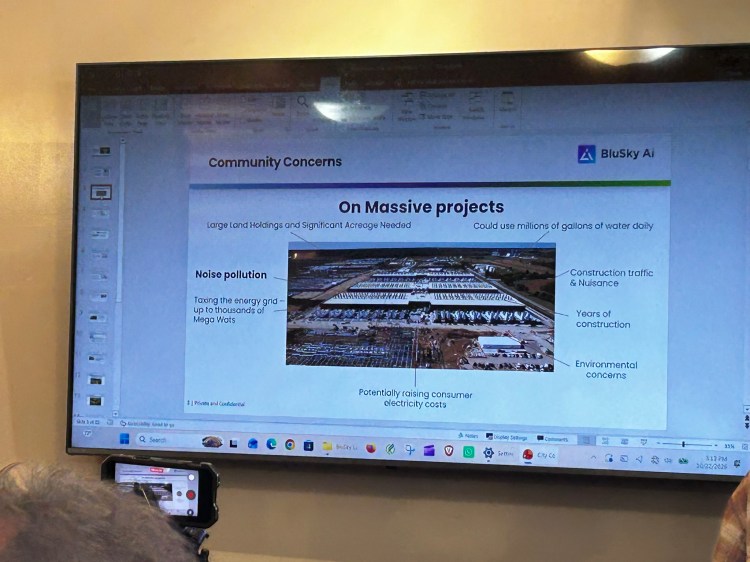
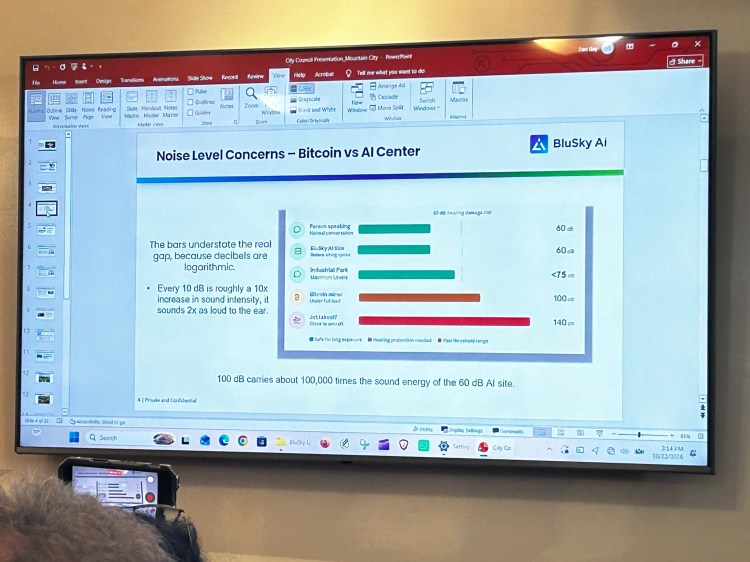
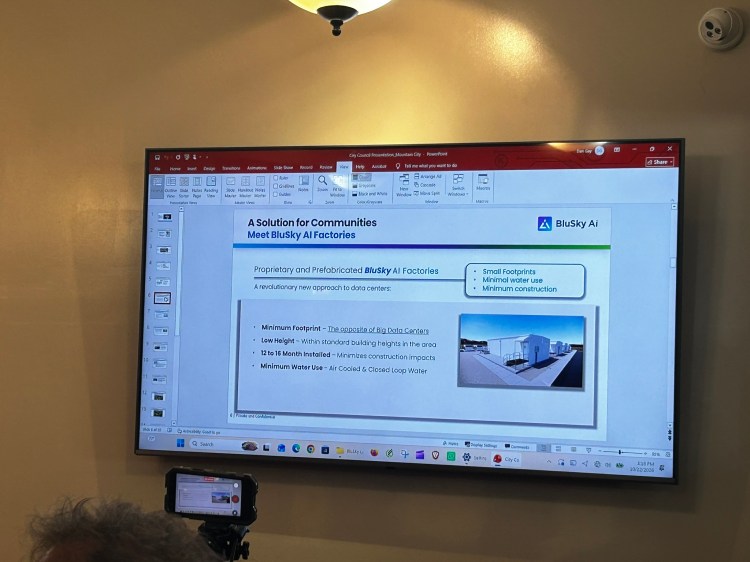
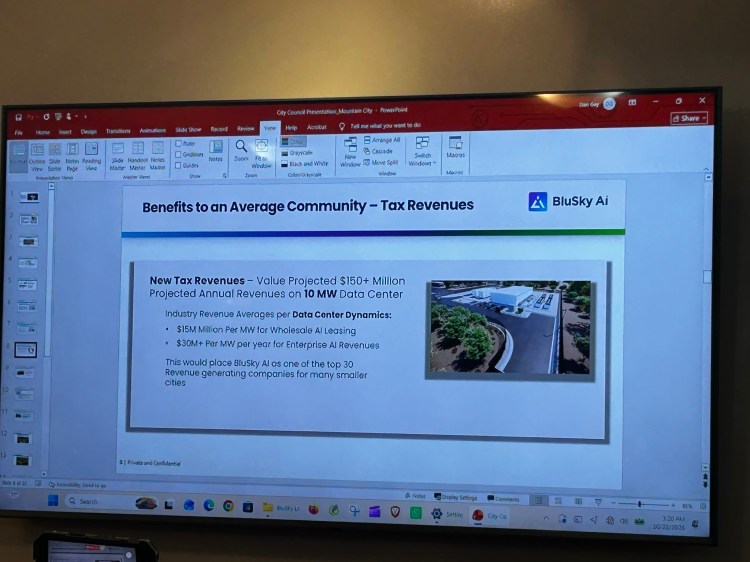
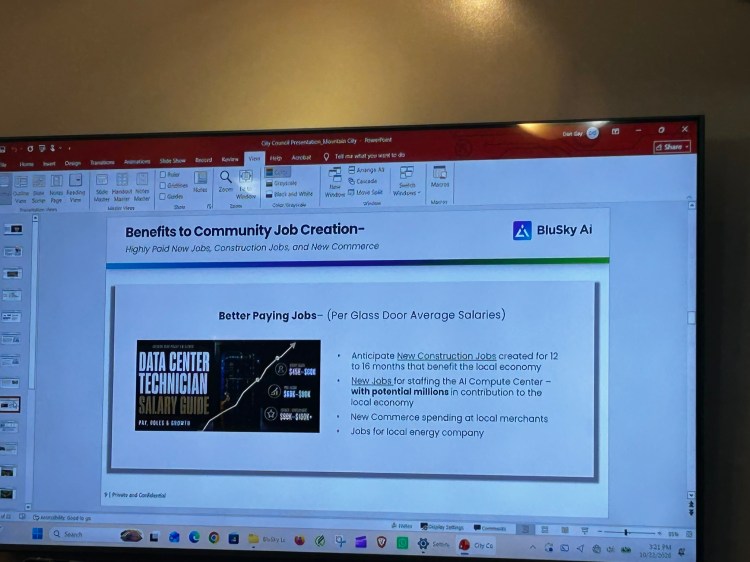
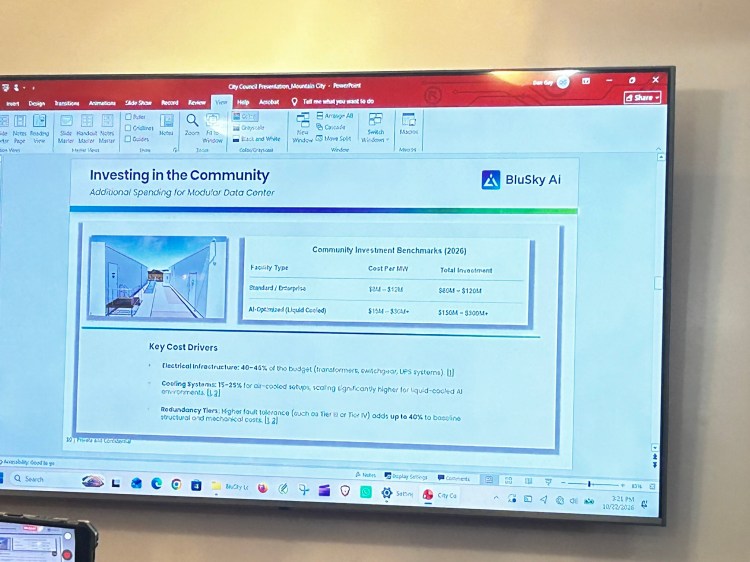
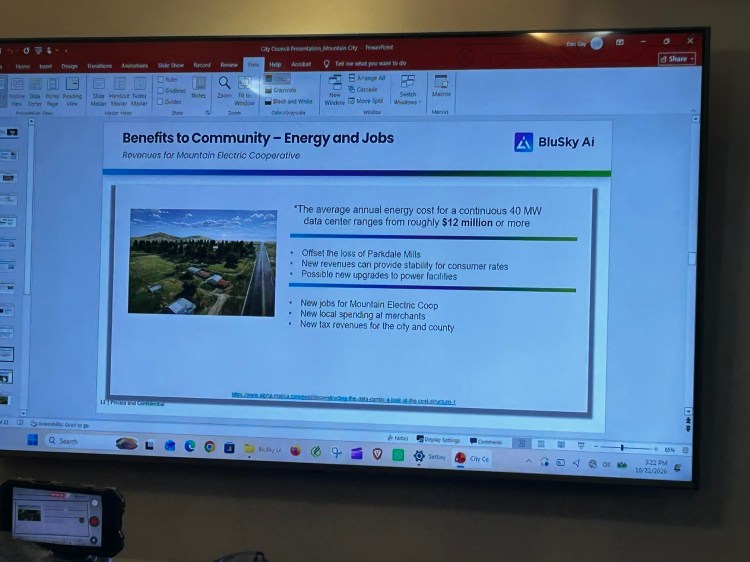
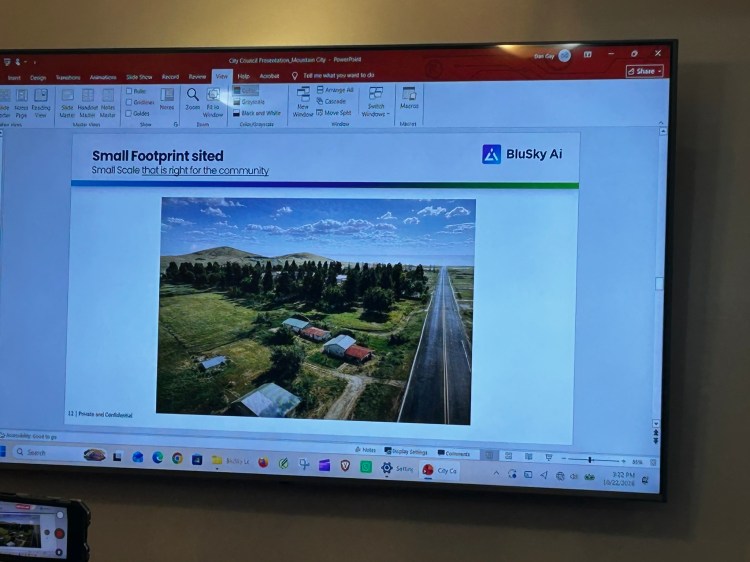
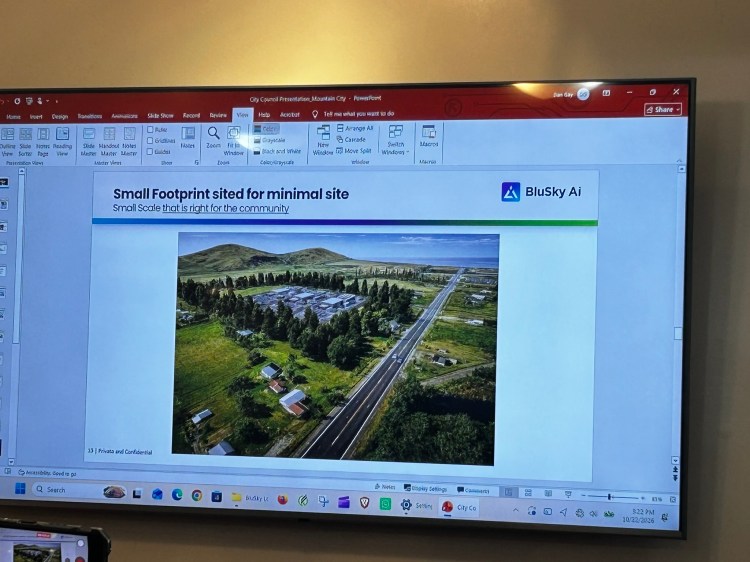
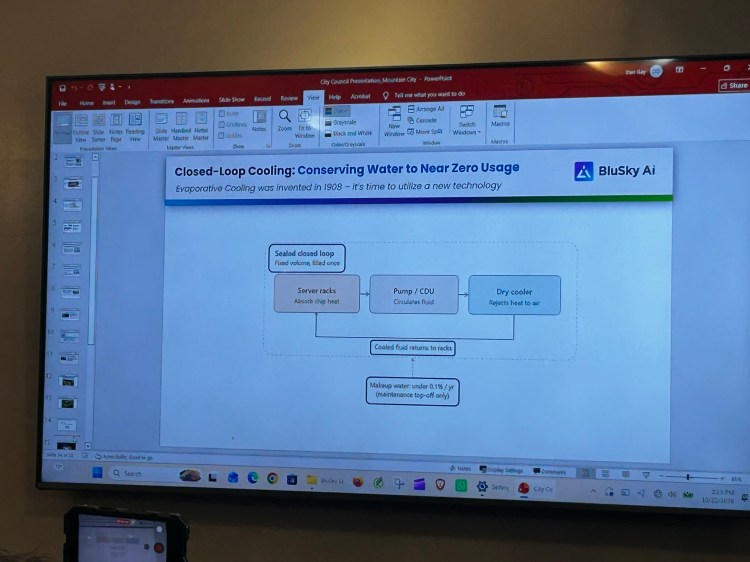
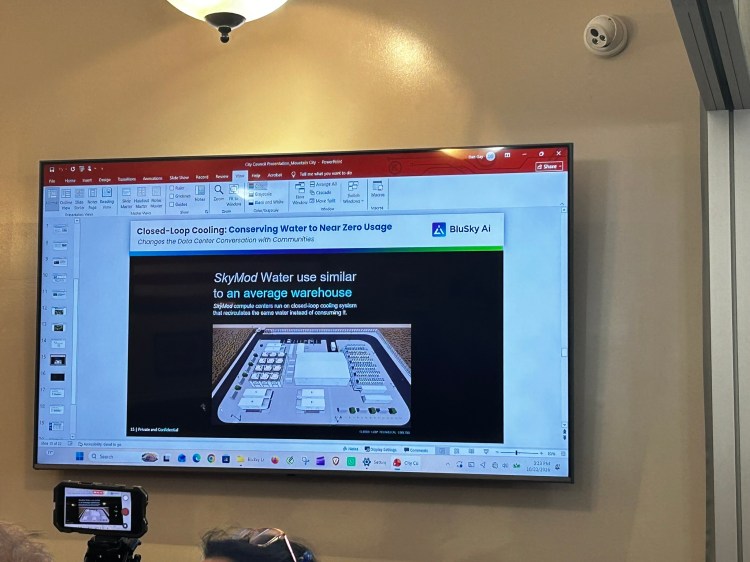
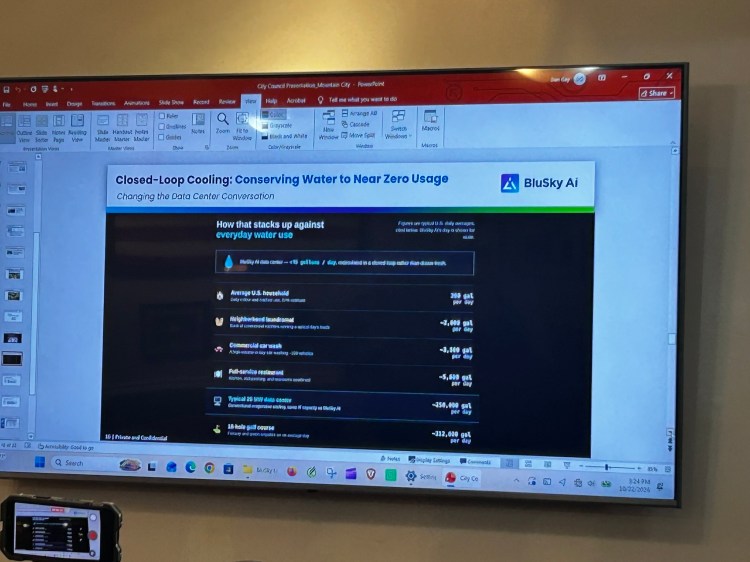
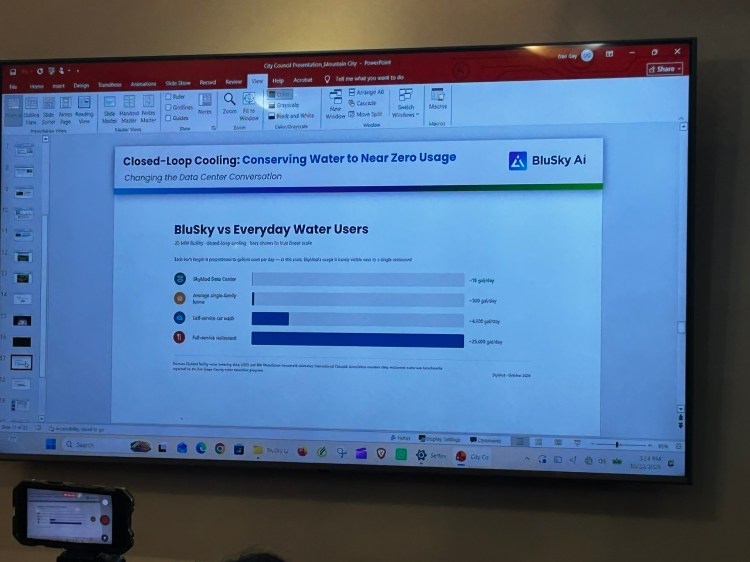
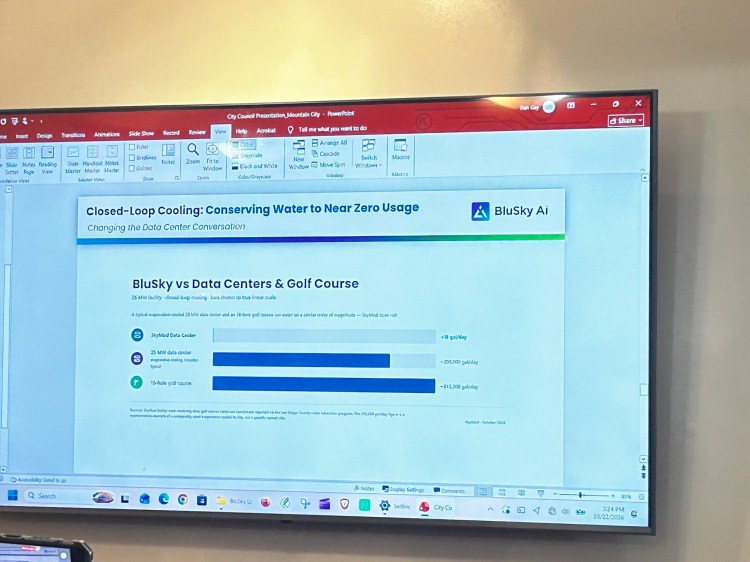
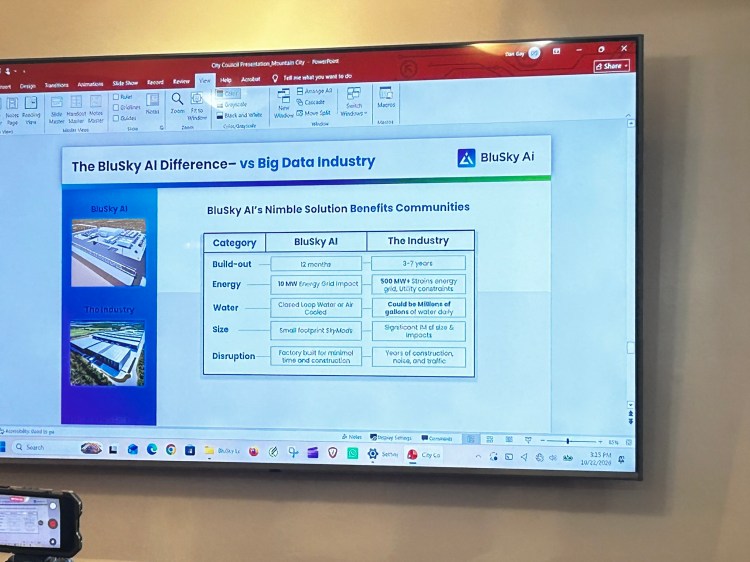
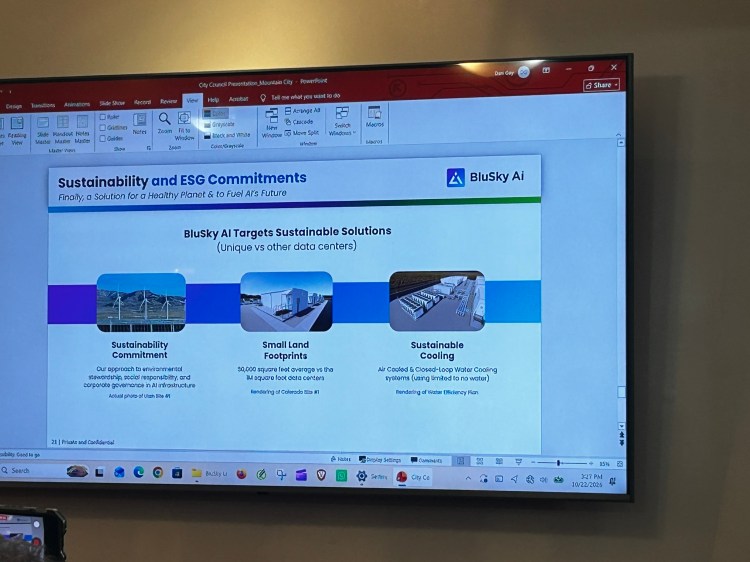
Representatives of BluSky AI spent a considerable portion of the meeting explaining why they believe their facilities should not be compared with traditional data centers or Bitcoin mining operations. (See photos of slides below.)
Dan Gay, the company’s chief operating officer, described BluSky’s approach as smaller, modular facilities that are manufactured elsewhere and transported to a site for installation.
The company presented images of prefabricated units that would be placed on concrete pads, rather than constructing a large traditional building.
Gay said the Mountain City project would include four modular units, with site development and installation expected to take approximately 12 months.
He also addressed several of the concerns raised by residents.
Water usage: According to company representatives, the proposed facility would use approximately 15 gallons of water per day for routine domestic needs (i.e., bathrooms and kitchen). They described a closed-loop cooling system that circulates fluid rather than relying on the large quantities of water used by some conventional data centers.
Noise: BluSky representatives estimated noise levels of approximately 45 to 55 decibels, which they compared to ordinary conversation and other everyday sounds.
Electricity: Company CEO Michael Ahlin said the proposed facility would require approximately 30 to 40 megawatts of electricity, depending on available capacity.
Jobs: Gay estimated the project would create six to nine permanent jobs, which he described as higher-paying technical positions. He also discussed the possibility of scholarships and training opportunities.
Infrastructure: Representatives said BluSky would pay for electrical infrastructure upgrades required to serve its facility.
Tax revenue: The company suggested the project could provide significant new revenue for local government and additional income for Mountain Electric Cooperative.
Those are the company’s projections and explanations. Independent studies or documentation verifying the specific figures for the proposed Mountain City facility were not presented during the meeting.
And that distinction matters.
What about the company’s track record?
One question raised during the meeting was whether BluSky AI currently operates any facilities that residents or town officials could visit.
Gay acknowledged that BluSky does not yet have its own operating facilities, although he said the company works with partners whose facilities could provide examples of the technology.
Company representatives offered to provide locations and noise studies for further review.
Questions were also raised about the company’s financial condition, including reported negative earnings.
Michael Ahlin, BluSky CEO, described the losses as part of the development and investment phase of the business and discussed the role of customer contracts and financing in bringing projects to completion.
Still, the discussion left some questions unanswered.
Who would be the customer for the proposed Mountain City facility? What financing arrangements would support construction? And what independently verified information could the town review before making a decision?
Those are reasonable questions when considering a development that could have a long-term impact on a community.
Planning staff also recommends against the change
One of the more significant moments of the meeting came when Daniel Campbell, a planner with the First Tennessee Development District who works with Mountain City, addressed the commission.
Campbell said he could not, in good conscience, recommend moving the rezoning forward.
He pointed to the town’s 2010 Transportation and Land Use Policy, specifically an industrial land-use objective on page 44 addressing activities that could negatively affect public health, safety, welfare, the environment, or the community’s economic potential.
Campbell also suggested that a facility of this nature might be more appropriately considered outside the town limits, where county land-use requirements differ.
His recommendation was important because it brought the discussion back to the town’s own planning policies — and whether the proposed zoning change was consistent with those policies.
Questions About Planning Commission Membership and Thursday’s Vote
Another question emerged following Thursday’s meeting — was the Mountain City Planning Commission properly constituted when it conducted business?
Tennessee law requires municipal planning commissions to have at least five members. However, Thursday’s meeting proceeded with four members following the resignation of Kody Norris.
According to Norris, he submitted his resignation to Mayor Jerry Jordan approximately a month ago because a serious family matter required his attention.
Following the meeting, The Johnson County Line spoke with City Attorney Annie Wright about the vacancy and whether the commission could legally conduct business, including approving minutes and voting on the proposed M-2 rezoning.
Wright said she had studied the issue and believed the commission could proceed because all four remaining members were present and constituted a quorum. She compared the situation to a meeting in which one member was absent, such as being away on vacation.
We questioned that comparison, pointing out that an absent member is different from a vacant position. In one situation, the commission still has five members, even if only four attend. In the other, the fifth position is unfilled.
Wright maintained that because Thursday’s vote was unanimous, the commission could proceed. She said that had the vote been split, the issue would have been addressed and the matter tabled until the commission was back to full membership.
We also questioned why the outcome of a vote would determine whether the commission could legally conduct business, and why the vacancy had not been disclosed and addressed before the meeting began.
Wright stood by her interpretation.
Under Tennessee Code Annotated § 13-4-101, municipal planning commissions must have no fewer than five members, and vacancies in appointed positions are to be filled for the remainder of the term.
The question is whether a commission operating with an unfilled seat can continue taking official action, and whether the outcome of a particular vote makes a legal difference.
The law establishes the membership requirement, but whether Thursday’s actions were legally valid despite the vacancy remains a question requiring further clarification.
The Johnson County Line will continue seeking clarification on the commission’s membership, its procedures, and the legal basis for Thursday’s actions.
What happens now?
Thursday’s unanimous vote means the Planning Commission is not recommending approval of the requested M-2 zoning change.
That is a significant setback for the proposed BluSky AI project, although it is not the same as a final rezoning decision by the Board of Mayor and Aldermen.
There are also questions that remain worth exploring, regardless of what happens with this particular proposal.
How much tax revenue would a modular data center actually generate for Mountain City, especially if the property is only leased and not purchased? How would that revenue be calculated? What protections would be in place for neighboring property owners? And what documentation would be required to verify the company’s claims about noise, water use, and electricity?
Those questions deserve answers before any similar proposal moves forward. Based on the meeting today, it is – in our opinion – doubtful this will happen. It was mentioned that land in Johnson County should be considered since “they have no zoning codes.”
For now, Thursday’s meeting offered something that residents have been asking for — an opportunity to be heard, a discussion of the proposal, and a decision that reflected the concerns expressed in the room.
Mayor Jordan acknowledged the potential economic opportunity, but he also acknowledged the people who came to speak.
And when the vote was taken, the Planning Commission was unanimous.
The Johnson County Line will continue following this proposal and any further action by the town.


Excellent article and well written!
LikeLike
Thankyou, Robert! We appreciate your support.
LikeLike
What would be required to expand the area outside of the city limits for additional mountain city residents to run for office
LikeLike
That would probably require annexation of those areas. I would wonder if people in the county would want to be annexed into the town limits as they would have to then pay both county and town tax with limited benefit for it. What do you think?
LikeLike
Ask Jerry jordon what businesses he has brought into town, none
LikeLike