There are some events you go to because there is good food, good music and something fun to do on a fall weekend.
And then there are those events that tell you something about the community that created them.
The Shady Valley Cranberry Festival is one of those.
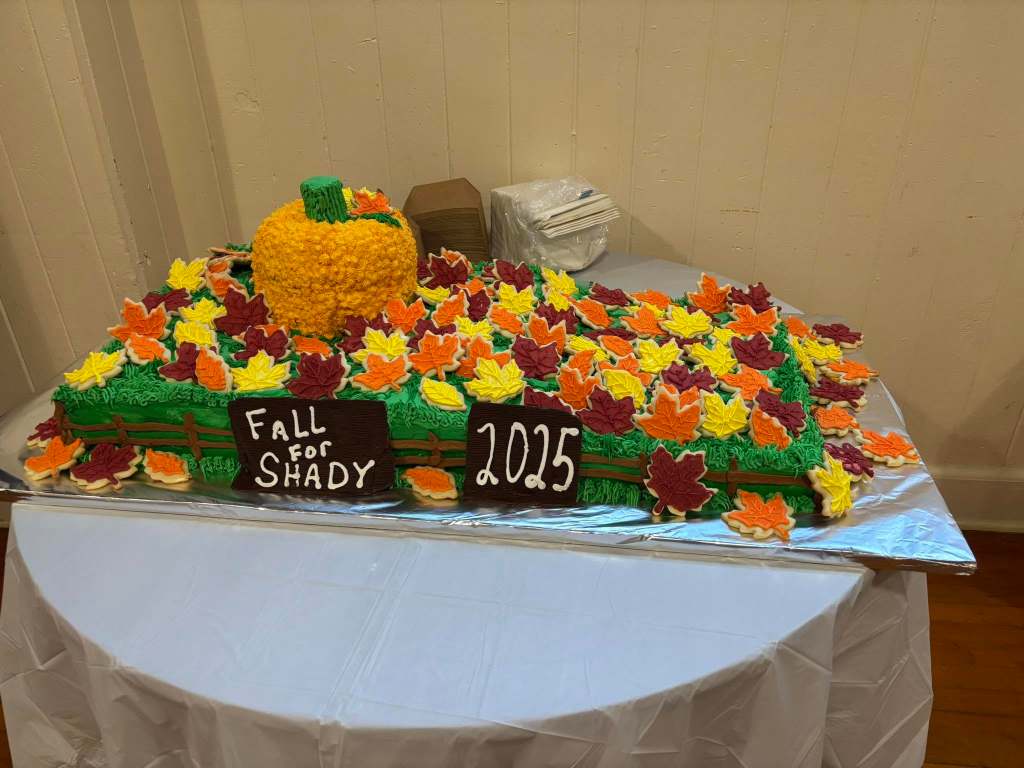
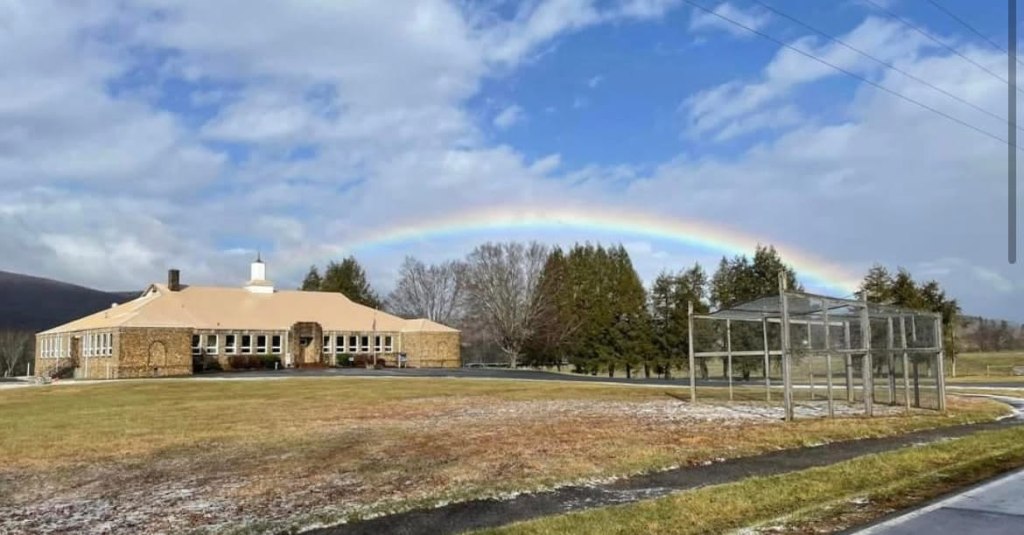
On Friday and Saturday, October 9–10, people will once again make their way to Shady Rock School for what has become one of Johnson County’s most beloved fall traditions — the soup bean supper, auctions, vendors, food, music, dancing, a parade, history and, yes, that famous Cranberry Festival cake.
This will be the 34th year for the festival.
But to really understand the Cranberry Festival, you have to go back to where it began.
And, as I learned during a recent conversation with one of its founders, you also have to understand that the festival has never really been just about cranberries.
It has always been about Shady Valley, its children and its school.
It started with a school fundraiser
I recently sat down — by phone — with Diana Howard, whose name kept popping up as I went through old newspaper stories about the early Cranberry Festivals.
And by early, I mean really early.
All the way back to 1992.
Howard and Shady Valley teacher Maggie Hand were among those who got the whole thing started.
Like parents everywhere, Howard remembers those little school fundraisers that inevitably came home with the children — candy, spices or whatever else everyone was supposed to sell door-to-door.
And she wasn’t particularly fond of them.
By the time you enlisted the parents, called all your friends, collected the orders, delivered everything and chased the money, it was an awful lot of work for a relatively small return.
Howard thought there had to be a better way.
Something that could raise real money for the school.
Something the entire community could be part of.
So they set out to learn how to do it.
Howard told me she and Karen Buckles went over to Bristol’s Fun Fest, where organizer Wallace Coffey essentially allowed them to become festival apprentices for the day. They were put in staff shirts and followed people around, watching and learning how a community festival actually worked.
Then they came home to Shady Valley and started one.
There was a hot-air balloon. There were helicopter rides. There was music and food and vendors and activities.
And there was plenty of community support.
Howard remembers Tommy Walsh, Paul Brown and Danny Herman as three of those early supporters who helped get them started financially.
And they needed a name.
That’s where the cranberries came in.
Why cranberries?
Today, someone hearing “Cranberry Festival” for the first time might assume somebody in Shady Valley simply decided cranberries sounded appropriately fall-ish.
Not so.
The cranberries are part of the valley’s history.
A wonderful story I found in the September 16, 1992 edition of The Tomahawk — published just before the very first Cranberry Festival — explained just how unusual Shady Valley’s natural environment really is. The newspaper described the high, cool valley as a place where plants more commonly associated with areas much farther north could survive, including wild cranberries growing in boggy areas of the valley.
At one time, over 130 years ago, those cranberries grew much more abundantly.
But according to that 1992 account, channelization of much of the valley floor in 1965 destroyed most of the natural cranberry habitat.
A small portion survived on property owned by the Jess Jenkins family, whose family had held the land for generations and wanted to see the bog preserved. The Nature Conservancy eventually purchased the property, and the remaining area became known as the Jess Jenkins Wild Cranberry Bog.
So when those first festival organizers were trying to find a name that was distinctly Shady Valley, they landed on something that belonged to the valley itself.
Howard laughed when she remembered one little detail they hadn’t completely thought through.
Once you call something a Cranberry Festival, people naturally show up looking for cranberries.
And cranberry everything.
“We didn’t think about how these people were going to come in wanting cranberries — cranberry this, that and the other,” she recalled.
There were only so many cranberries to go around.
But the name stuck.
Thirty-four years later, it is hard to imagine calling it anything else.
The festival was born inside the school
There is another small detail from that 1992 newspaper story that caught my attention.
Because today, it feels especially significant.
As residents prepared for that very first festival, people gathered at Shady Valley School to learn about the cranberry bog, Native American artifacts and the history and traditions of the valley.
And there, inside the school, a new banner was created announcing the birth of the annual Shady Valley Cranberry Festival.
Think about that for a minute.
The festival that would spend nearly three decades helping support Shady Valley School was itself born inside that school.
And helping the school was the point.
Howard said money raised by the festival helped teachers purchase classroom supplies and other things they needed — without continually reaching into their own pockets.
“The whole big reason for doing it was to raise money … to help the teachers buy supplies and things for the school,” she told me.
But it became more than supplies.
Festival proceeds also helped give Shady Valley children experiences outside the classroom.
Howard remembers trips to Dollywood and even taking students to the Martha Washington Inn for dinner — cloth napkins and all.
Those trips mattered to her because some children might never otherwise have had those experiences.
And because children who went to school together also got to experience life together.
They built friendships and connections that lasted beyond the classroom.
That sense of community is something Howard still talks about today.
Then the school closed
The fear that Shady Valley might lose its school wasn’t new.
Howard remembers hearing discussions about the possibility years before it actually happened.
But in September 2019, the Johnson County Board of Education voted 3–2 to discontinue operation of Shady Valley Elementary following the 2019–2020 school year. Read more here …
For a community where the school had long served as far more than simply a place children went from 8 to 3, it was a painful loss.
But Shady Valley didn’t walk away from the building.
The community kept it alive.
The old school became a community center. People held meetings and events there. They preserved photographs and artifacts there. They continued maintaining the building.
And, perhaps most importantly, they kept holding the Cranberry Festival there.
Howard told me there was always another thought tucked away in the back of her mind.
Maybe someday children could return.
“We still hoped that there would somehow we’d get a school back,” she said. “And we are now presently on the ground floor … but we are trying to get a school back in there.”
Could Shady Valley have a school again?
Before anyone gets too far ahead of this story, let’s make one thing very clear.
This is an idea in its early stages.
There is no approved school.
There is no final model.
There are a lot more questions than answers.
But there is a serious enough interest that people in the valley have begun exploring what might be possible.
Possibilities discussed so far include a charter school or potentially some form of private or Christian school.
Howard told me one of her biggest concerns with any private-school model would be making certain children aren’t excluded simply because their families cannot afford tuition.
Her goal is simple: if there is going to be a school in Shady Valley, she wants the children of Shady Valley to have an opportunity to attend it.
Organizers also need to know just how many children that might be.
Based on two early meetings, Howard said they believe there may be somewhere around 45 to 50 children represented across various ages and grades.
But there’s a big unknown in that number.
Homeschool families.
There really isn’t an easy way to know how many children in the valley are currently being homeschooled or how many of those families might be interested in a local school option.
So the next step is pretty straightforward.
Ask.
Howard said Shady Valley Postmaster Mandy Hartman suggested a communitywide mailing with a detachable response form that could go to households throughout the valley.
And organizers want people to send it back whether their answer is yes or no.
They aren’t trying to convince every family to participate.
They are trying to get an accurate picture of whether there are enough families interested to take the next steps.
Those next steps could include forming a larger working committee and beginning the much more complicated process of answering questions about funding, state requirements, inspections, curriculum, grades and exactly what type of school might work.
Howard said former State Senator Rusty Crowe has helped connect organizers with someone knowledgeable about charter schools at the state level. She also said Hugh Marron, who has previous experience helping establish a charter school, has been helping the group understand the process and explore whether the idea is feasible.
Six directions from one valley
One thing Howard said during our conversation really stayed with me.
When Shady Valley Elementary was open, the children of Shady Valley went to school together.
Today, she said, children living within the valley are scattered in multiple directions.
Some attend school in Mountain City.
Some go to Roan Creek.
Some go to Laurel.
Some go to Doe.
Some attend school across the state line in Damascus.
Others are homeschooled.
“That’s six different directions in a 12 square mile valley,” Howard said.
Think about what that means beyond education.
Children living a few miles from one another may never be classmates.
Families are driving across mountain roads.
Grandparents and extended family members who might once have helped with school pickup or activities may not be able to make those longer drives.
And some of those challenges become even more significant during a Johnson County winter.
For Howard, though, there is another piece to this.
She believes something can be gained in a smaller school where teachers have an opportunity to truly know their students and recognize when one of them begins falling behind.
She talks openly about struggling with math herself as a child and how different things might have been if someone had caught it earlier and helped her in a way that worked for her.
She sees possibilities in hands-on education, vocational learning and finding the thing that makes an individual child want to learn.
That is part of what she hopes people will explore as these conversations continue.
And that brings us back to this weekend
Which is why this year’s Cranberry Festival feels like a particularly good time to tell this story.
Thirty-four years ago, some parents and teachers decided there had to be a better way to help their school.
They created a festival.
That festival helped support teachers and students.
When the school eventually closed, the festival helped keep people coming back to the building.
And now, in that same building where the Cranberry Festival was born, people are beginning to talk about whether children could someday go to school there again.
That’s a pretty remarkable full circle.
But first, it’s festival weekend.
Cranberry Festival kicks off Friday
The 34th Shady Valley Cranberry Festival begins Friday evening, October 9, at Shady Rock School.
The soup bean supper begins at 5 p.m., with proceeds benefiting the Olan Bentley Memorial Scholarship Fund. Bentley was a longtime supporter of both the school and the festival.
A silent auction will run from 5–8 p.m., followed by the live auction beginning at 7 p.m. Proceeds from the auctions will help support future projects at the school.
And let me just add this from personal experience:
That auction is no little table of donated odds and ends.
I did a pretty good chunk of my Christmas shopping there last year.
Come prepared.
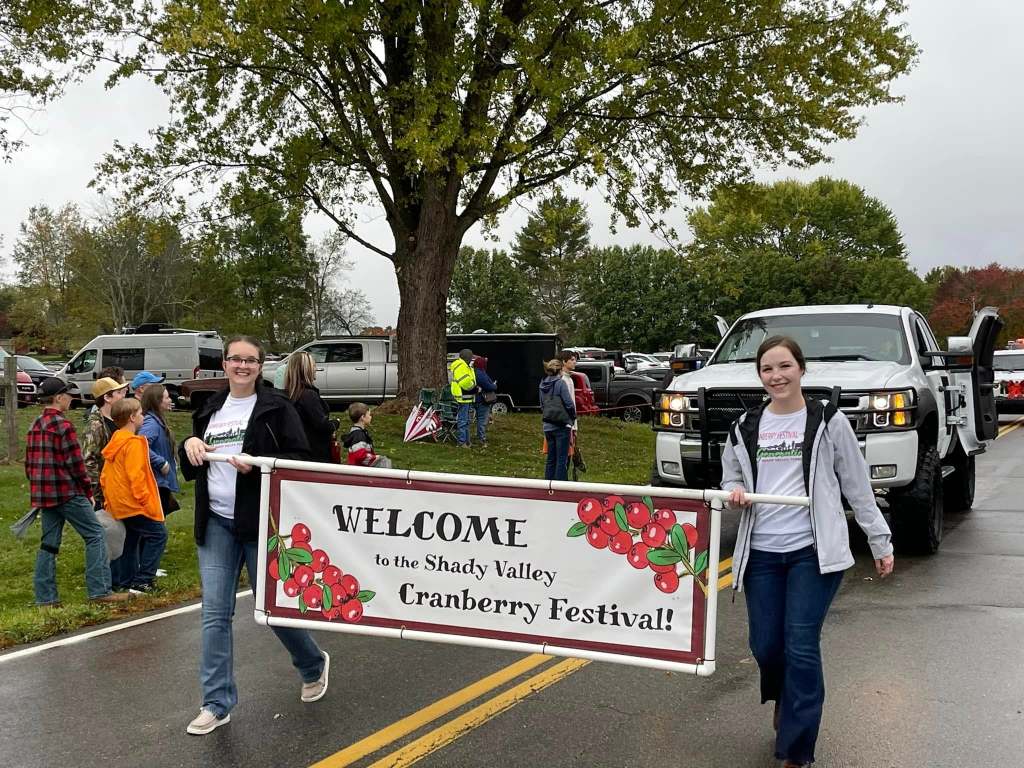
Saturday begins with the parade at 10 a.m.
Organizers say this year’s festival will have one of its biggest vendor turnouts yet. More than 20 vendors will fill rooms inside Shady Rock School, with additional vendors outside, for an expected total of somewhere around 50 to 60 vendors.
There will be plenty to eat, including one of those Shady Valley favorites — chicken salad croissant sandwiches — along with other food and snack options.
There will be cloggers and dancers, and Mike Long will coordinate live music beginning around 11 a.m. and continuing until approximately 4:30 p.m.
Kids can enjoy an all-day inflatables and mini-golf area for $5.
And don’t just walk through the school looking for vendors.
Spend some time looking at the school itself.
The stories inside Shady Rock
Howard told me Joyce Browder and Jackie Sluder Grindstaff have spent countless hours working with families throughout the valley, gathering photographs, writing down stories and documenting Shady Valley genealogy.
The history room includes notebooks organized from A to Z, preserving family connections and pieces of local history that might otherwise disappear.
The materials stay at the school, but visitors can spend time looking through them and photographing information that connects to their own families.
And another longtime festival tradition continues nearby.
Kenneth Sluder’s Native American artifact collection, which Howard said has been part of the festival every year, can be found in what was once the library behind the school.
Then, of course, there is the cake.
If you’ve been to the Cranberry Festival, you know the cake.
Howard remembers it as part of the festival almost from the beginning — auctioned off for what sometimes became a pretty impressive amount of money and then cut up and shared.
Apparently there are some things in Shady Valley that simply aren’t up for discussion.
There will be cake.
More than a festival
As Howard and I talked, I kept coming back to that old 1992 newspaper clipping.
A tiny surviving cranberry bog.
A group of people gathered inside their community school.
A handmade banner announcing a brand-new festival.
They couldn’t possibly have known what it would become.
They couldn’t have known that 34 years later people would still be gathering at that same building every fall.
They couldn’t have known the school would eventually close.
And they certainly couldn’t have known that one day another generation of Shady Valley residents would be sitting around talking about whether it might become a school again.
But maybe that’s what community traditions are supposed to do.
They give us something that connects what was to what is — and, sometimes, to what still might be.
The Shady Valley Cranberry Festival has certainly done that.
Yes, there will be vendors.
There will be music, bean soup, an auction, a parade, history, children playing and plenty to eat.
But underneath all of that is a story that has been there since 1992.
A community determined to take care of its own.
And maybe, just maybe, the next chapter of that story is beginning right where the first one did.
Inside Shady Rock School.
Shady Valley residents should also watch for information regarding the community survey about potential interest in a future school at Shady Rock. Organizers are asking households to respond whether they are interested or not so they can determine whether there is enough support to move the idea forward.
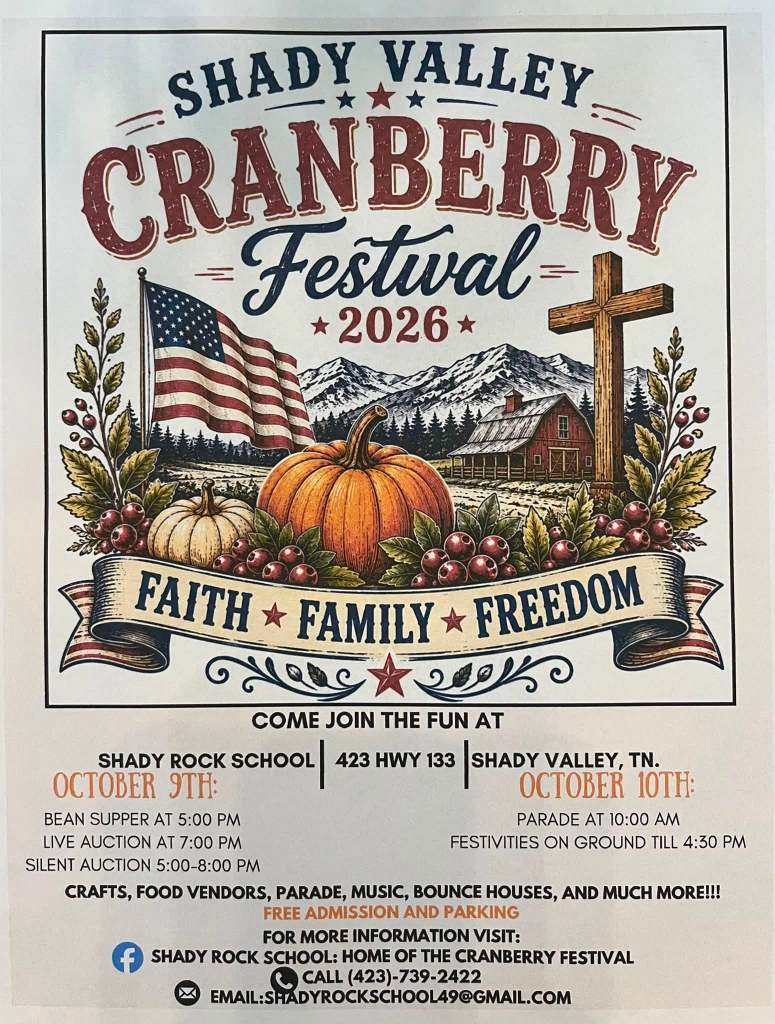
Festival Information
Shady Valley Cranberry Festival – Facebook Page
Friday
Soup Bean Supper — 5 p.m.
Silent Auction — 5–8 p.m.
Live Auction — beginning at 7 p.m.
Saturday
Parade — 10 a.m.
Vendors, food, history displays and children’s activities throughout the day
Live entertainment — approximately 11 a.m.–4:30 p.m.

