Johnson County Trails Association sees an interconnected trail system as more than recreation—it could generate hundreds of thousands of dollars in new revenue and create opportunities for locally owned businesses.
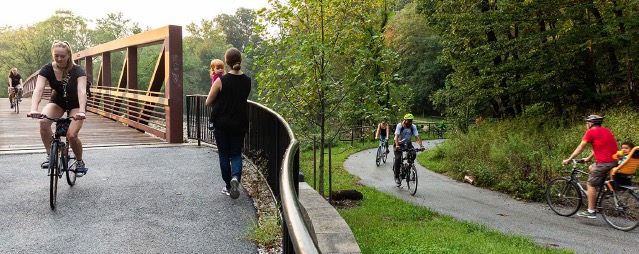
A network of trails connecting Butler to Damascus is on its way and could bring close to a million dollars a year in increased revenue to Johnson County. That is the vision put forth by the Johnson County Trails Association (JCTA) in its ambitious 15-year master plan, which will also incorporate Doe Mountain Recreation Area and Backbone Rock. But just in case you look at that 15-year number and shrug, the first three projects—the Laurel Creek Extension, the Iron Mountain Trail, and the Johnson County Trail Center—are anticipated to be completed within three years.
Philip Burtt-Henderson, the president of JCTA, says that while the first three projects alone will likely result in revenue streams of at least $650,000, his primary focus is on providing Johnson County residents with a safer, more accessible way to enjoy the place they already call home. “It’s for locals first, and then there’s a second- and third-order effect that other people might want to come and enjoy it.”
For Johnson County runners, walkers, and bicyclists, that could eventually mean being able to leave Ralph Stout Park and travel roughly 14 miles without having to share the road with cars. The envisioned greenway running from Ralph Stout Park to the Laurel Creek Trail would provide a dedicated route for running, walking, and biking and eliminate the often terrifying and dangerous practice of walking along the shoulder of Highway 91.
Locals are already enjoying the first project: the partially completed Laurel Creek Extension, which has punched its way well into Virginia and is on the verge of being graveled. “Rock Bottom Construction cut us an amazing deal,” says Burtt-Henderson. “They’re going to start spreading it from the end back towards Tennessee. They’re doing it for like pennies on the dollar.”
This part of the project has been funded by smaller grants from the East Tennessee Foundation, Operation Pocket Change, the Hometown Service Coalition, and an anonymous $40,000 grant through the Rails-to-Trails Conservancy. But the final portion will require bigger money and bigger grants, so JCTA will be seeking funds from sources like the Appalachian Regional Commission, the U.S. Department of Transportation, and others. The final portion of the trail will require crossing Laurel Creek several times but will also utilize portions of the old roadway and old abutments, giving it some cool history as well. Burtt-Henderson envisions this final segment, which will connect the Laurel Creek Trail to the Creeper Trail outside of Damascus, costing in the range of a million dollars. No money from Johnson County Government has been or is anticipated to be used to fund the project.
The second stage of the plan involves the Iron Mountain Trail, which begins at Cross Mountain and ends in Damascus. This project was pretty much ready to go, funded by grants and awaiting reclassification by the U.S. Forest Service to be used as a mountain bike trail. Then Helene happened.
“I lost count,” Burtt-Henderson says. “I’ve hiked it twice, and there are about a thousand blowdowns, and root-balls.” Brandon Church, the trail technician for Cherokee National Forest, has coordinated crews to scout the trail, and hotshot crews from Montana, Utah, and North Dakota have helped cut a path through. But the rest will be up to JCTA, which has a Memorandum of Understanding with Cherokee National Forest to manage the trail.
Once it is reclassified as multi-use, the 18-mile trail, which boasts a 2,000-foot elevation drop, will be an adventure tourism draw as a mountain biking trail. But, as with the larger trail network, it won’t just be for visitors. Local hikers and mountain bikers will have an 18-mile recreational trail in their own backyard, with connections that could eventually take them to Backbone Rock and the Appalachian Trail. Burtt-Henderson envisions the restoration and maintenance being done primarily by volunteer crews, with some of the grant money already earmarked for the project being used to hire additional workers. He estimates the project will be completed within 36 months.
The Iron Mountain Trail will also be used to connect the trail network to another one of Johnson County’s premier attractions. “So there used to be a county road that goes down to Backbone Rock, so we want that spur opened back up, so you can just turn left and go right down to Backbone Rock. And from there there’s a spur to the Appalachian Trail.”
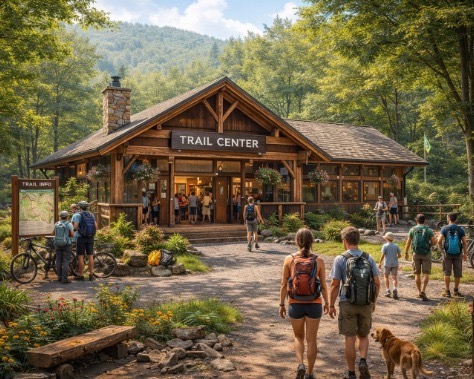
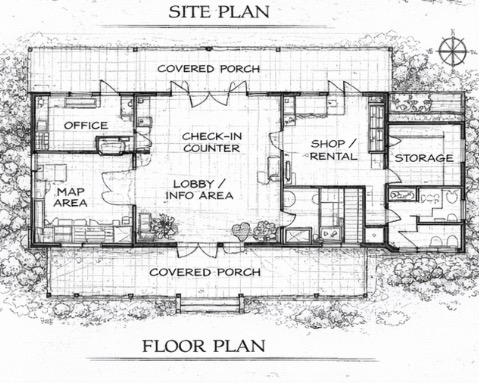
Another immediate priority for JCTA is the Johnson County Trail Center, which would be located on approximately four acres controlled by JCTA at the Laurel Creek Trail. Burtt-Henderson envisions the center as the northern gateway into Johnson County, turning pass-through visitors into Johnson County visitors and providing information on the growing trail network, as well as information on the history, culture, and heritage of the county.
But the Trail Center is also envisioned as a place for the people who live here. The center would serve as a community resource, hosting local events, youth education initiatives, and health and wellness programs, while giving Johnson County residents a central point of access to the growing network of trails.
JCTA is pursuing a $250,000 ThreeStar grant from the Tennessee Department of Economic and Community Development. “They loved the idea so much they assigned a consultant to us in Nashville,” Burtt-Henderson says. “They told me, ‘Hey, work with this person, and make this ready for the next iteration.’” The Hometown Service Coalition is lined up as well, if the grant comes through, to dedicate its entire 2027 fundraising effort to the Trail Center.
The combination of these three projects solidly moves Johnson County from the overlooked neighbor of outdoor recreation areas in Virginia and North Carolina to a dynamic player in the field. Providing more economic diversity is that secondary goal Burtt-Henderson mentioned.
“We have a strong entrepreneurial spirit here in the county. You see a lot of small businesses opening up, mom-and-pop joints, that people want to support.”
And that may be where the economic impact becomes most tangible for local residents. Burtt-Henderson isn’t envisioning an economy built around big outside companies coming in to capitalize on Johnson County’s natural resources. Instead, leaning into the natural beauty of the county—its trails, creeks, and mountains—could create opportunities for Johnson County residents to build small, family-run businesses of their own: a bike rental or repair shop, a hiking or fishing guide service, a trail shuttle, an outfitter, or an equipment rental business. Visitors may bring the dollars into Johnson County, but the idea is for local families and locally owned businesses to have an opportunity to benefit from them.
JCTA projects completion within three years for this phase, which will be followed by further projects like the multi-use Roan Creek Trail, which would follow the old railway line from Sink Valley through Neva, where it would connect with DMRA, and into Mountain City, where it would meet up with an extension of the Goose Creek Trail, connecting that trail to Ralph Stout Park.
From there, the proposed multi-use Laurel Greenway would connect Ralph Stout Park with the Laurel Creek Trail. For a local runner, walker, or bicyclist, the end result could be something Johnson County has never really had: a long, connected recreational route through the county that doesn’t require getting into a car and driving to a trailhead somewhere else. Ultimately, the network would provide an uninterrupted hiking, walking, and biking route from Butler through Johnson County and on to Damascus.
Additionally, as soon as JCTA receives the go-ahead from the U.S. Forest Service, it will begin work on restoring the Gentry Creek Trail, which was ravaged by Helene.
For Burtt-Henderson, this trail network is the fruition of an idea that came to him when he first moved to Johnson County six years ago. He and his son took their bikes out for a ride on the Laurel Creek Trail and, a quick mile later, came to the end of it.
“Wait a minute. Where does this go?” he remembers thinking. “Trails need to go somewhere, right? So we have a lot of trails in the county, but they don’t go to other places in the county. So that’s where our network comes in.”
If the plan comes together, those trails will go somewhere. They’ll connect the county from one end to the other, they’ll connect visitors to local businesses and local families to new opportunities. Most importantly they will give the people who already live here a new way to experience the mountains, creeks, and forests they’ve always called home.


One thought on “A Trail to Somewhere”