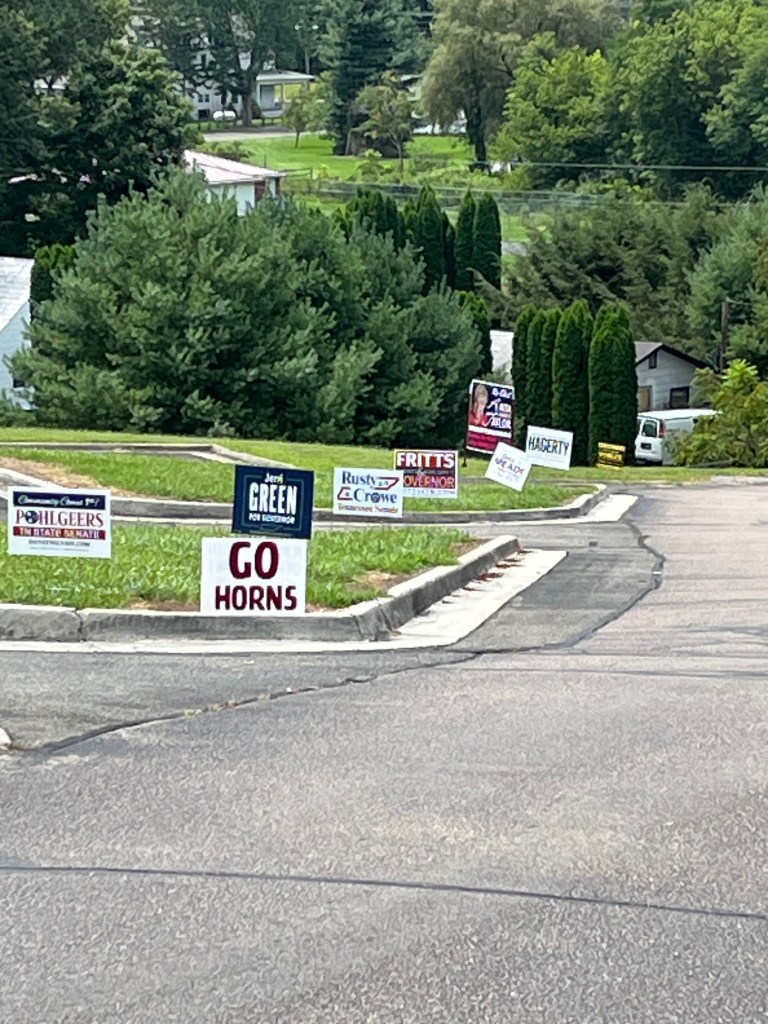
Around sunset on Thursday, August 6, the parking lot at the Johnson County Election Commission began filling up. It’s primary night in Tennessee, and the Johnson County Republican Party was busy turning it into a tailgating event, with sliders and cookies available to all. But even with the laughter, food and general goodwill, it was hard to escape the feeling that the election was about something larger than the candidates on the ballot: who gets to define a Republican in Johnson County—and who gets to decide what kind of county Johnson County will become.
Until this year, municipal elections in the county were nonpartisan. But Johnson County is deep red, in a deep red state, and it has generally been safe to assume that nearly everyone on the local ballot is a Republican. So when, in response to tightening requirements from the Tennessee Republican Party, Johnson County Republican Party Chair Randy Dandurand announced that local candidates would also appear on the May 5 Republican primary ballot, at first it seemed like a big so what.
Until the word bona-fide dropped.
To qualify for the Republican ballot, candidates had to, among other things, be active members of the Tennessee Republican Party and have voted in the previous three Republican primaries. Suddenly, incumbents faced the possibility that loyalty to the letter R, combined with general disinterest in the inside-baseball workings of political parties, could bounce them from office. Newcomers could find themselves shut out before they ever had a chance.
“In the (May 5) primary, we found 9 people that weren’t qualified to run as Republicans,” says Randy Dandurand, the chair of the Johnson County Republican Party. “We were gonna have everybody run as Republicans…until we had one person that really upset the apple cart.”
Nearby, Chad Greever, a school board member and community advocate, was also waiting for the county commission results. He remembers how he and others viewed the change.
“I see it as an attempt to control who gets on the ballot,” he says. “The biggest problem was you have a lot of people who were conservative candidates, but they started to feel as the bona fide process went on, it was going to be used against them.”
Across Tennessee, candidates were dropped from Republican ballots. But although the rules came from the state party, much of the resulting fury was directed at county organizations. Johnson County was no exception.
Dandurand expresses some frustration with how the state Republican party rolled out the requirements, and even more about how they were applied.
“They were shut down for a week and a half with an ice storm,” he says, referring to the late January storm that crippled most of the country. “They didn’t have electricity. They didn’t have any computers operating or anything. But instead of talking to the county chairs about maybe giving somebody a waiver that would be qualified, they basically made their own decisions on people that they don’t even know. I just wish they would have stuck to the rules entirely or just relaxed everything and just let everybody run and then see their voting history in the future.”
Greever agrees that the problem needs to be addressed at the state level.
“It was handled very haphazardly by Scott Golden, the state chairman, and then the state executive committee,” he says.
When asked whether he was aware of the problems the January storm created, Greever acknowledged that he had not heard about them.
But while the January storm complicated the primary process, another issue had already been roiling Johnson County politics.
In August of last year, residents successfully blocked the construction of a bitcoin mine within Mountain City limits, but immediately there was concern that the issue would arise again in the county, where the complete lack of zoning requirements would make it a snap for bitcoin mines or data centers to move in.
In response, county mayor Larry Potter introduced a resolution to adopt Tennessee’s county powers act, which would allow the county to limit certain types of businesses as outlined by the county commission. Despite what appeared to be overwhelming community support for the resolution, in a 7-6 vote, the county commission voted it down. The vote transformed what had been a debate over development and property rights into a political dividing line.
In an interview following the August 2025 vote, Dandurand indicated that the primary process could be used to target commissioners who voted against the resolution. “We’re going to look at each one hard and see which ones…are not representing the people like they should,” he told WUOT radio.
“That does not sit well with the mindset in this county with a lot of people,” Greever says. “They felt threatened and insulted after the meeting with the comment of essentially, you will do this or we will replace you.”
Dandurand and Greever were publicly on opposite sides of the fight. But they agree that the battle over development played a large role in what happened next.
In one of the most Republican counties in Tennessee, 18 of the 27 candidates for county commission appeared on the ballot as independents.
Only nine had failed the bona-fide test.
“Yes, without question,” says Greever. “I think that a lot of the people who chose to run as independents did it as a show of force or solidarity.”
But at the end of the day, was anything resolved?
Despite months of online vitriol, when the final county commission numbers came in, independents lost about as often as they won. So did Republicans. Among incumbents and challengers, no clear pattern emerged.
No mandate was revealed.
Of the incumbents who had voted on the County Powers Act, four who supported it returned to office. So did three who opposed it. Accounting for those on both sides who chose not to seek reelection, the whole thing looked remarkably like a draw.
And buried beneath a year’s worth of political division was an irony: Dandurand and Greever had supported the same compromise.
“The way they should have handled this, without question,” says Greever, “Would have been to issue a 1-year moratorium. That would have hit the pause button.”
“Let’s just step back and take a look at this thing, ” Dandurand agrees. “Let’s make a decision based on facts. Do some research, talk to some other towns.”
Johnson County has a strong libertarian streak, particularly when it comes to individual liberty and property rights. Both men embrace that tradition, although they draw the line in different places.
Dandurand argues that property rights should be protected until the exercise of those rights begins infringing on a neighbor’s.
Greever, who describes himself as a constitutional conservative, says protecting property rights takes precedence over protecting property values—but argues that doesn’t have to end the discussion.
“I have no great love of data centers. I have no great love of Bitcoin,” he says. “But a one year moratorium that would have hit the pause button, it would have given everyone a chance to look at it, to see what they thought of it, and then it should have been placed on the ballot as a ballot referendum. Let the county decide. Let the public decide.”
So maybe, after a year of anger and division that produced no clear winner and no obvious mandate, Johnson County has arrived back where it started.
Maybe it’s time to talk about it again.

